- A supply line, sanitary drain, storm drain and foundation drain perform different jobs.
- A camera report should identify the inspected route, observations, access and visibility limits.
- Municipal pipe maps describe their stated segment; neighbourhood age does not diagnose your private pipe.
- Restoring flow, repairing a defect and verifying a completed repair are different outcomes.
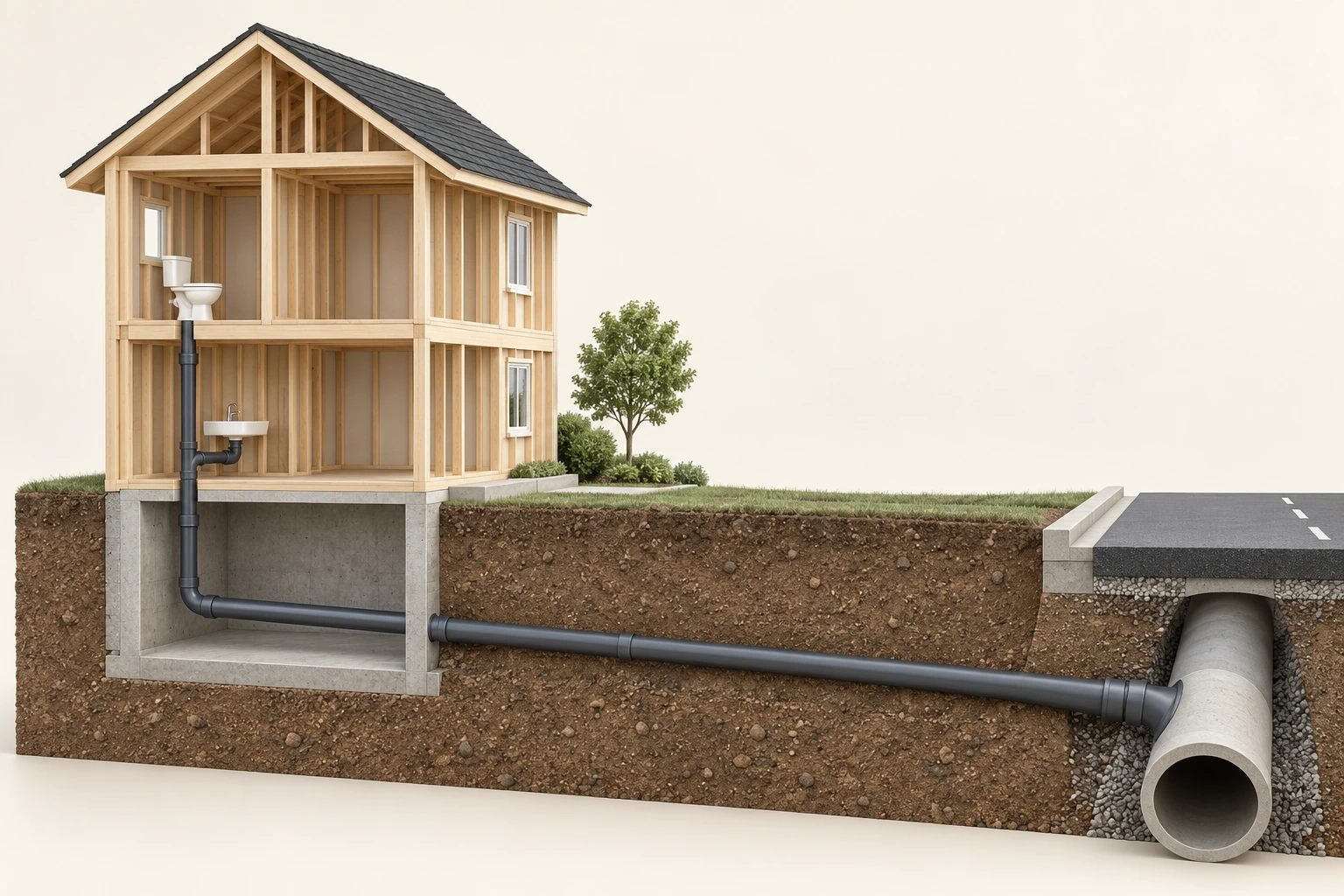
The toilet and sink join a building drain. A buried connecting pipe then reaches the larger sewer under the road. This is one simplified municipal-sewer example; venting and an actual property’s arrangement are not fully drawn.
About this illustration
No installed material, measured slope, complete vents, pump arrangement, boundary, ownership, leak tightness, condition or approval is established. Rural homes may have an onsite destination. This is a conceptual teaching model, not an assessment of your home.
6 picture lessons appear beside the questions in this guide. Use them to understand the explanation, then consider what it means for your home.
Where does water go after a shower?
Used water leaves the shower through its drain. That drain joins other pipes in the building; a larger connecting pipe carries the wastewater from the house towards its destination. When the home connects to a municipal sewer, that connecting pipe is often called a sewer lateral.
Follow the route in order: fixture, drain branch, building drain, connecting pipe and municipal sewer. A rural property may use an onsite wastewater system instead. Ask which destination serves this home before interpreting a pipe drawing.
Gravity carries wastewater downhill in many drainage routes. Some installations need a pump to move wastewater to the next part of the system. Calgary describes its larger collection network as using both gravity and pump stations; a house needs its own identified arrangement.
A toilet flushing today is one observation. It does not show the condition of every buried joint or what will happen during the next heavy rain. A useful house record names the route, the parts that were actually observed and the stretches still unknown.
Follow used water from the fixture to the street
The toilet and sink join a building drain. A buried connecting pipe then reaches the larger sewer under the road. This is one simplified municipal-sewer example; venting and an actual property’s arrangement are not fully drawn.
Numbers identify the parts explained below.
- Fixtures
The toilet and sink discharge used water into connected drainage.
- Building drain
The drain collects wastewater from the connected fixtures before it continues outside.
- Buried connecting pipe
The route crosses the yard and joins the larger sewer under the road in this conceptual example.
What does this illustration leave out?
No installed material, measured slope, complete vents, pump arrangement, boundary, ownership, leak tightness, condition or approval is established. Rural homes may have an onsite destination. Read each part and its job below the picture.
Which destination serves this home, and which accessible records or observations identify the actual route?
Explore this with HomeAI ↗Opens an editable question. Nothing is sent until you choose to send it.Why do drains need traps, vents and cleanouts?
The curved pipe beneath a sink is usually part of a trap. A working trap retains water, creating a barrier between the room and gases in the drainage system. A curve visible in a photograph does not establish that the installed trap is holding its water seal.
Drainage also needs an air arrangement. Venting allows air movement and helps protect trap seals as wastewater moves. A simplified house picture leaves out many vent connections; use the plumbing guide to understand their job, then ask a qualified plumber about the actual arrangement.
A cleanout is an opening provided for servicing a drain. It gives a professional a place to reach the pipe without assuming that every capped fitting is a sewer access. Ask which accessible opening serves the route you want inspected and keep the identified access reachable.
Record slow drainage, gurgling or odours with their timing and affected fixtures. These symptoms can have different causes. Do not open a sewage-filled or pressurised cleanout, climb onto the roof, or open finishes to prove a theory. In a shared building, establish permission and scope with the building contact.
Are sanitary, storm and foundation drains the same thing?
Sanitary drainage carries used water from toilets, sinks, showers and other fixtures. Storm drainage handles rain and snowmelt in the installed local arrangement. Foundation drainage collects water near below-ground construction and sends it through its intended discharge route.
These jobs explain why one successful observation cannot clear all three systems. A running sump pump does not inspect the sanitary sewer. A sewer camera does not automatically inspect the perforated drainage around the foundation. A downspout repair answers only the stated work.
Combined sewers and older property connections can complicate the route. Ask a plumber to identify what is actually connected and what local rules apply. Toronto’s guidance describes foundation drains, sewer connections and protective devices separately; that example is not a connection recipe for another home.
After a water event, describe where water first appeared, the weather and any known equipment operation from a safe place. A floor drain can receive water from elsewhere as well as being a possible entry point. Give the responder the sequence before choosing a cause.
Which water route are we actually discussing?
Follow one function at a time. A successful sump discharge and a clear sanitary sewer are different observations.
On a small screen, scroll across the diagram. The explanation below covers the complete route.
- Sanitary: used water from fixtures; identify the building’s actual municipal or onsite destination.
- Storm: roof and surface water; the installed arrangement and local rules determine where it goes.
- Foundation: collected water near below-ground construction; the discharge arrangement needs its own records.
These rows are examples, not a connection plan. Combined systems and property-specific arrangements exist. A sewer-camera scope does not automatically include foundation drainage.
Which pipe family am I looking at?
Three questions belong together: what is the pipe made of, what job was it intended to do, and what condition was observed? A name or colour alone cannot answer all three. Repairs can leave different materials along the same route.
Clay, cast iron, concrete, PVC, ABS and bituminous fibre are different pipe families. The picture lessons help you understand the names. Product markings, work records and qualified identification are needed for an actual stretch; a neighbourhood’s age is not a material identification.
PVC and ABS are plastic families with particular products and applications. IPEX distinguishes solid PVC sewer products from perforated drainage products and publishes a Canadian ABS drain, waste and vent range. Similar appearance does not make two products interchangeable or establish local acceptance.
Orangeburg is a name associated with bituminous-fibre pipe. Pinellas County explains the wood-pulp and coal-tar material and possible deterioration. That American material reference supplies no Canadian installation era, prevalence or local responsibility rule.
If a seller says “all the sewer was replaced,” ask for the start and end of the work, the named materials and the completion records. A new visible piece near the house can coexist with unexamined buried sections. Preserve an uncertain pipe name as a question for the specialist.
Six families: identity, application and condition are separate
These repeated wall specimens deliberately use the same basic shape. A silhouette or colour cannot identify what is buried at your home.
Clay
Ceramic family
Check the actual pipe and joint identification; age or neighbourhood alone is insufficient.
Cast iron
Metal family
Verify which stretch is metal and whether repairs left mixed materials along the route.
Concrete
Cementitious family
Request identification and condition observations separately; the specimen shows neither age nor defects.
PVC
Plastic family
Read product markings and approved application; solid sewer pipe differs from perforated drainage pipe.
ABS
Plastic DWV family
Drain, waste and vent is an application. A dark appearance does not certify ABS or approval.
Bituminous fibre
Orangeburg name
A wood-pulp/bituminous material family. Obtain identification; do not transplant a foreign installation era.
Conceptual specimens; wall thickness, joining method and dimensions are not a product specification. No Canadian installation era or local prevalence is assigned. A camera finding needs the provider’s identification, observed condition and coverage limits.
How do roots reach the inside of a sewer?
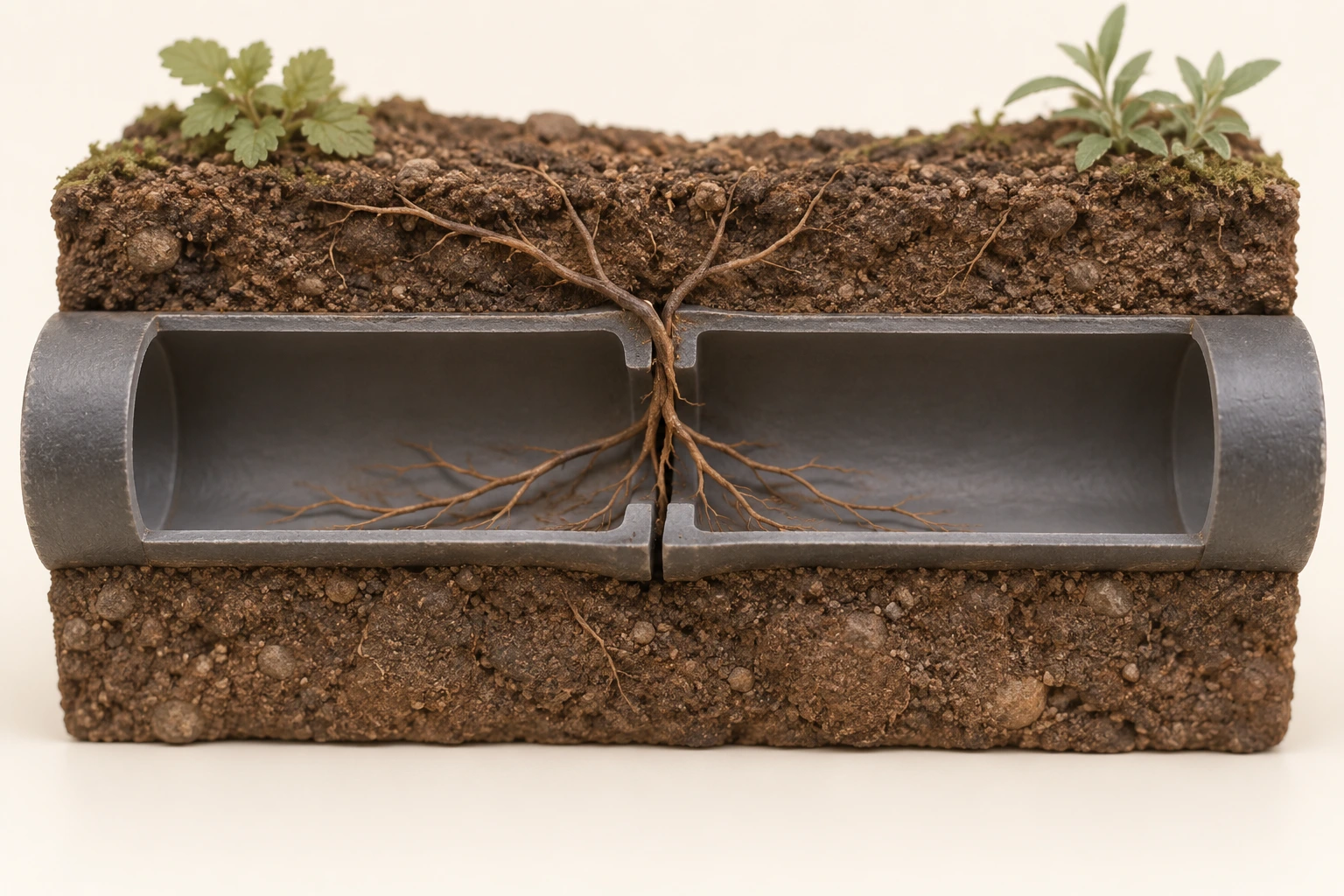
Roots can enter where a joint, crack or separation gives them an opening. The close-up picture follows that possible entry into the pipe’s passage. It does not show what caused the opening at a real home.
Calgary’s poplar guidance describes roots growing where faults offer water and air. Winnipeg also describes roots entering at joints, cracks and separations. A tree near the route therefore raises a useful question; it does not prove that roots occupy the sewer.
Cutting roots may restore passage while leaving the opening. Ask where roots were observed, whether the joint or pipe wall was visible after cleaning and what follow-up the provider recommends. “Roots removed” and “entry route repaired” describe different outcomes.
Do not turn a pipe finding directly into a tree-removal decision. Tree permissions and the actual pipe assessment are separate matters. A specialist should explain the observed condition and relevant options rather than borrowing a universal cleaning schedule from another property.
An opening at a joint can give roots a way inside
The close-up shows roots entering an open joint and growing into the pipe’s passage. It helps explain an entry route; it does not show how the opening developed at a real property.
Numbers identify the parts explained below.
- Opening at the joint
A gap gives roots a possible route from the soil to the pipe’s inside.
- Roots in the passage
Growth inside a pipe can interfere with passage. The actual extent needs the provider’s observations.
- Pipe beyond the picture
A local close-up cannot establish the condition of the remainder of a sewer.
What does this illustration leave out?
No actual pipe material, original cause, extent of blockage, measured defect, assessed condition or repair decision is established. Nearby vegetation does not prove roots inside another pipe. Read the labelled explanation below the picture.
After cleaning, could the provider see the entry point, and what evidence supports the proposed follow-up?
Explore this with HomeAI ↗Opens an editable question. Nothing is sent until you choose to send it.What can a sewer scope show?
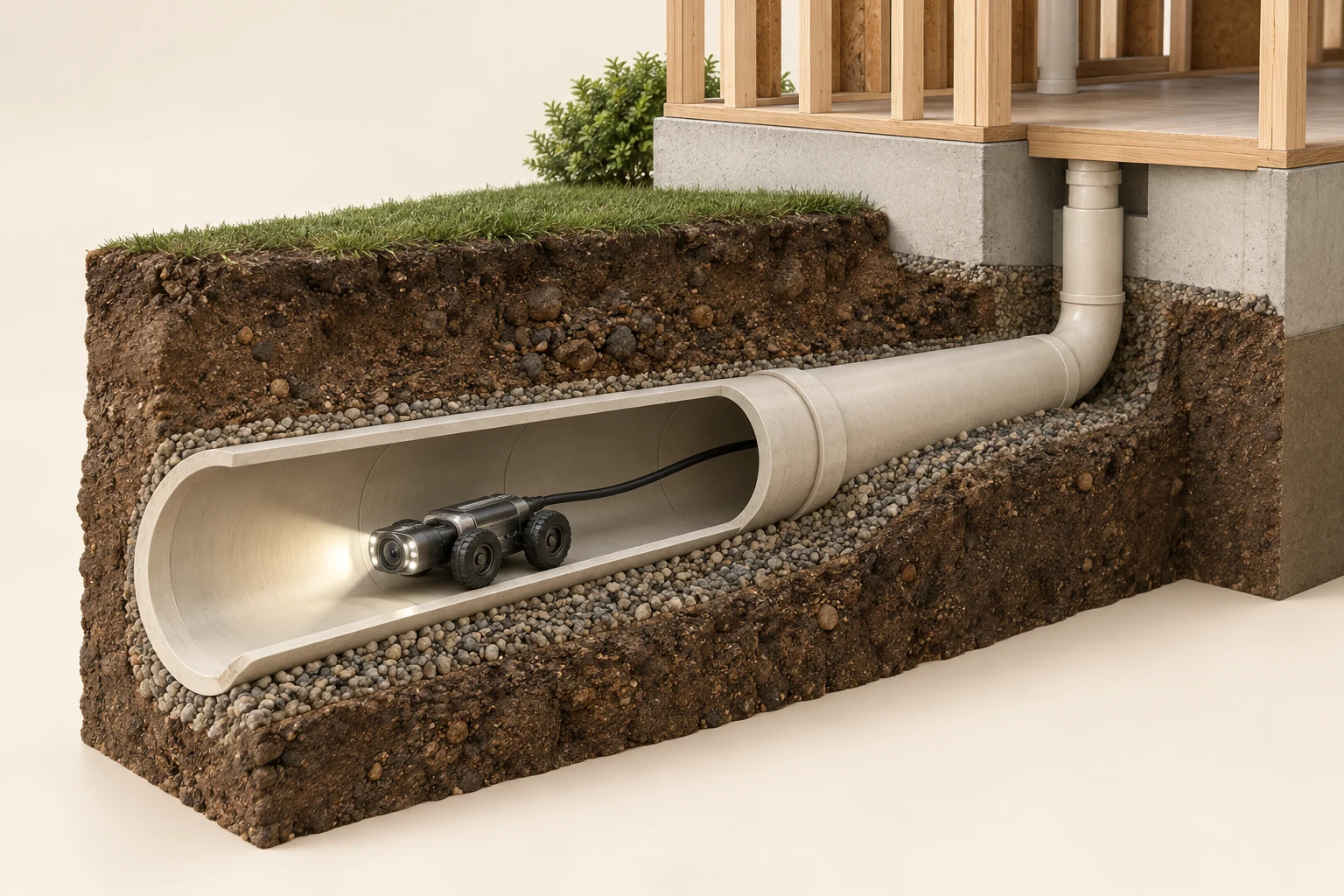
A sewer scope uses a camera to view the inside of an accessed pipe. It can record visible roots, deposits, displaced joints, damage or standing water along the route it reaches. Ask for the recording and a report explaining the important observations.
The handover should identify the address, date, access point, direction and inspected start and end. Keep those details beside the findings. A report about one branch is not automatically a report about the complete connecting pipe to the municipal sewer.
Water, deposits, bends or an obstruction can hide the surface or stop the camera. The unviewed remainder stays unknown. Keep pre-cleaning and post-cleaning recordings in sequence because they can show different things.
The camera’s inside view does not measure every outside condition. A distance counter does not by itself locate a point on the lot, and perspective does not calculate the pipe’s slope. Ask which additional method would address location, grade, shape or leak tightness when that is the decision. Calgary’s engineering reference treats camera inspection and deflection testing separately.
The camera looks at the pipe’s inside surface
The camera head views the inside of the pipe. The cutaway also reveals surrounding soil, but that outside support is not visible in an inside-camera recording.
Numbers identify the parts explained below.
- Camera and light
The camera records the inside surface that its view can reach.
- Cable
The cable connects the camera with equipment outside this close-up.
- Outside the pipe
The illustration exposes soil for explanation. An inside recording does not inspect all that soil.
What does this illustration leave out?
No actual recording, camera model, travel direction, distance, complete route, outside support condition, measured grade, leakage test or inspection finding is supplied. Read each part’s job below the picture.
Does the report name the address, date, access, direction and inspected start and end?
Explore this with HomeAI ↗Opens an editable question. Nothing is sent until you choose to send it.How should I interpret roots, offsets and standing water?
Start with the observation, its position in the recorded run and the provider’s explanation. Roots are visible plant growth. An offset means the adjoining pipe ends do not line up at a joint. A crack is an observed wall feature. Standing water can hide part of the surface.
Water in one frame does not settle why it is there. A low section, an obstruction, downstream conditions or recent discharge may need consideration. Ask what the provider observed during the visit and which method supports the explanation.
If a report calls a section low, ask whether grade was measured or the conclusion came from the camera view. If the camera stopped, ask what prevented travel and which downstream stretch remained unseen. These questions make the report useful without declaring a whole route sound or failed.
For a purchase, connect a material recommendation with the recording, location, relevant options and remaining unknowns. Your realtor can coordinate records and transaction timing; the scoped technical assessment supplies the pipe findings. A worrying still frame alone is a weak basis for choosing a repair.
A camera report needs a start, an end and an honest gap
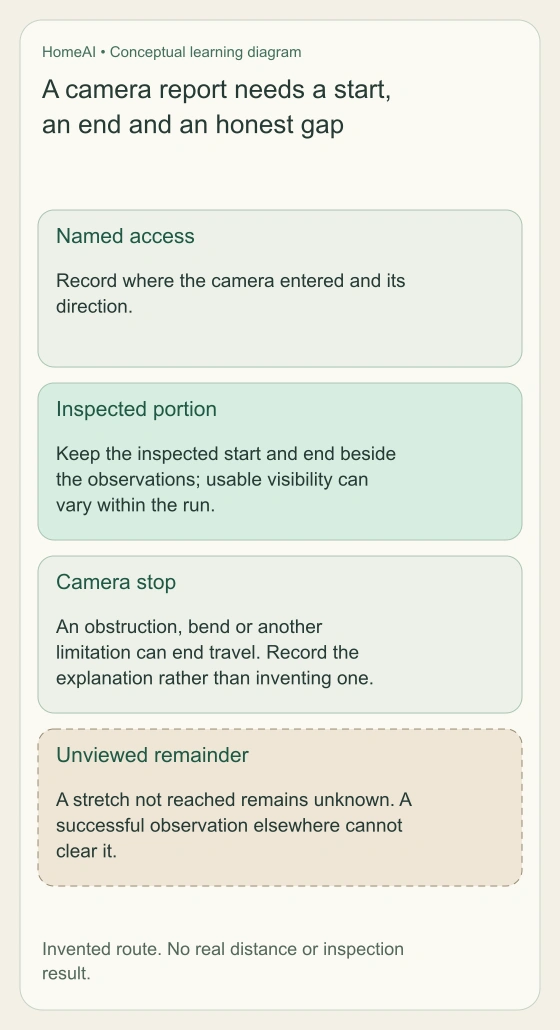
The green panel names the inspected portion. The dashed panel preserves what stayed unviewed when the camera stopped. These are conceptual report fields, with no real distance or property result.
Numbers identify the parts explained below.
- Start and direction
The report identifies where the camera entered and which way it travelled.
- Inspected portion
Describe the route reached and which surfaces were actually visible.
- Stop and remainder
Name the reason travel ended when known, and preserve what was not viewed.
What does this illustration leave out?
No route length, actual access, cause of a stop, downstream condition, measured location or complete inspection is supplied. The complete coverage explanation follows below.
Which exact stretch and surfaces were covered, and what needs another method or a later visit?
Explore this with HomeAI ↗Opens an editable question. Nothing is sent until you choose to send it.Read the complete diagram
A camera report needs a start, an end and an honest gap
- Named access
- Record where the camera entered and its direction.
- Inspected portion
- Keep the inspected start and end beside the observations; usable visibility can vary within the run.
- Camera stop
- An obstruction, bend or another limitation can end travel. Record the explanation rather than inventing one.
- Unviewed remainder
- A stretch not reached remains unknown. A successful observation elsewhere cannot clear it.
Conceptual coverage only: no measured distance, actual property finding or diagnosis of a camera stop.
What remains unknown: No route length, actual access, cause of a stop, downstream condition, measured location or complete inspection is supplied.
Why ask about a sewer on a new build?
New materials do not eliminate construction-stage questions. Ask which installation and acceptance checks covered the private route, which records are available, and whether there was later site work. A new-build camera scope can be a useful additional question, especially where an inspector or contractor identifies an unresolved concern. Its value comes from the defined scope and decision, not from assuming every new home has damage.
Buried flexible pipe and its surrounding soil work as a system. Calgary’s engineering reference considers loading, soil support, pipe stiffness and construction cover together. Construction traffic therefore belongs in a question about the actual installation; seeing a truck on a yard does not establish that it damaged a pipe. The appropriate assessment needs the route, material, support and work history.
Keep installation acceptance, occupancy status, warranty processes and private due diligence distinct. Calgary states that City site inspection does not substitute for supervision and due diligence by the owner, engineer or contractor. A municipal approval is useful evidence of its actual scope. It should not be expanded into a promise that every concealed component was observed after all later work.
Who owns the pipe under my yard and street?
Ownership and maintenance rules are local. In Calgary’s public service-line dataset, the City-owned segment runs from the sanitary main to the property line; the homeowner-owned segment runs from the property line to the house. The metadata warns that the private segment can have a different material and installation date. Actual easements and property-specific arrangements still need checking.
Winnipeg’s published responsibility page is different: the owner’s private sewer runs to the connection at the City main, including under the street. Its assistance process has conditions and exclusions. This contrast matters when reading a Canadian guide: the sidewalk, lot line and ownership boundary should not be drawn as the same universal dividing line.
Request the current local rule, survey or title information where relevant and the service report locating the issue. An approximate camera distance does not prove which side of a legal boundary contains the defect. Do not assign fault or tell an owner who must pay until the physical location and applicable responsibility have been established.
The pipe’s location and its maintenance responsibility are different questions
These two municipal examples show why a property line is not a universal sewer-maintenance boundary. Calgary and Winnipeg describe different responsibilities. Confirm the current rule, property arrangement and any applicable assistance separately.
Numbers identify the parts explained below.
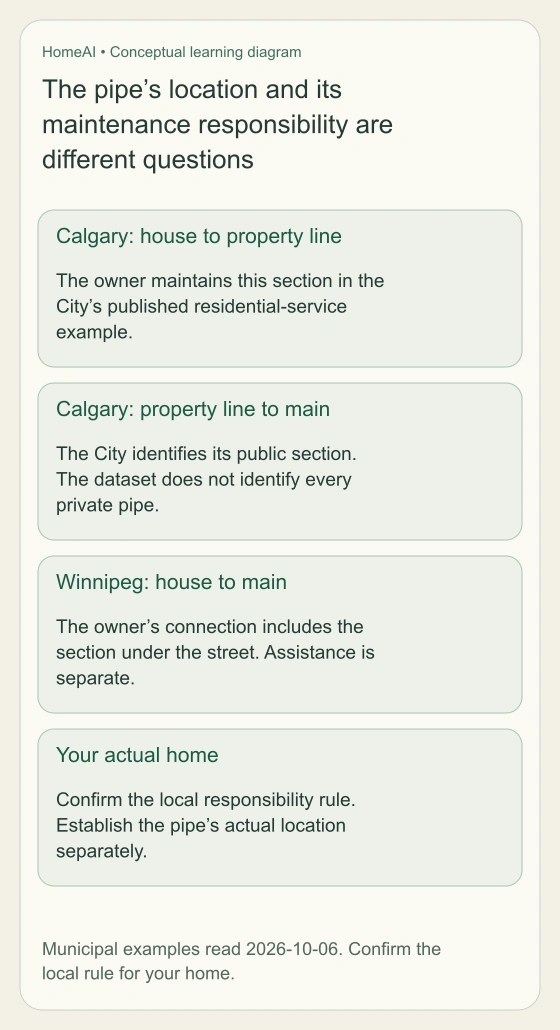
- Calgary example
City guidance distinguishes the main-to-property-line section from the owner’s property-line-to-house section.
- Winnipeg example
City guidance describes the owner’s connection extending to the City main, including under the street.
- Actual home
A location record and the applicable local responsibility rule answer separate questions.
What does this illustration leave out?
No actual property boundary, pipe location, ownership finding, eligibility for assistance, agreement or rule for another municipality is established. Read the full municipal comparison below.
Who maintains each stretch here, and what evidence locates the work being proposed?
Explore this with HomeAI ↗Opens an editable question. Nothing is sent until you choose to send it.Read the complete diagram
The pipe’s location and its maintenance responsibility are different questions
- Calgary: house to property line
- The homeowner is responsible for this section in the City’s published residential-service example.
- Calgary: property line to main
- The City identifies this public section; its dataset does not identify every private pipe.
- Winnipeg: house to City main
- The City describes the owner as responsible for the connection, including the part underneath the street. Assistance has its own conditions.
- Your actual home
- Confirm the serving municipality, arrangement and applicable responsibility. Establish location separately from the rule.
Municipal primary guidance read October 6, 2026. These examples supply no responsibility or assistance decision for another property.
What remains unknown: No actual property boundary, pipe location, ownership finding, eligibility for assistance, agreement or rule for another municipality is established.
What does Canyon Meadows’ sewer record actually tell me?
HAUSE’s September 24, 2026 analysis joins Calgary’s Public Sanitary Service Lines dataset to official community boundaries. Its Canyon Meadows row contains 2,170 mapped City-side records, with a recorded median installation year of 1972. The raw material counts are TIL 1,697, PVC 380, CIPP 56, OTHER 18, CI 11 and UNKNOWN 8. These figures describe a dated municipal-segment snapshot, not a sample of inspected private homes.
The code TIL is retained as the City’s recorded code because the dataset metadata does not define that abbreviation. A percentage headed confirmed clay, or a claim that 78.2% of houses have root defects, would go beyond this evidence. The public dataset also excludes large commercial and multi-family services. The City has updated the data since the snapshot; the existing aggregate is therefore labelled with its actual analysis date.
Use the record to form better property questions: is the private pipe original or replaced, what material did the specialist identify, is there an available repair or service history, and does any scope cover the full relevant route? Neither the community name nor the public-side median identifies the material, condition or roots at an individual address.
Which Calgary records are useful before buying?
Calgary’s 311 sewer-maintenance directory includes property-owner requests for service history and specifies signed owner authorisation for realtors or contractors. It also lists a submission method that should be confirmed directly with 311 before relying on a transaction deadline. Ask the seller for permission early and keep the official record separate from the seller’s recollection.
A history of City attendance can add dates, observations or work context. An empty or unavailable history does not certify a private line. Calgary’s sanitary utility section maps show broader infrastructure and can support professional planning; they do not constitute a condition inspection of a residential private lateral. Licensing and map scope also matter if you intend to reuse their content.
The same service directory says City sewer-video appointments are at a foreman’s discretion, rather than citizen-requested appointments. A buyer should not assume a free municipal camera inspection can be booked on demand. Agree the private inspection scope, access and delivery dates with the provider; in Alberta, check the licensed home-inspection business and inspector where that service applies.
Does a backwater valve solve sewer problems?
A backwater valve is intended to limit reverse flow through the route it protects. A sump pump moves collected water through its own discharge system. Neither repairs a cracked sewer, removes roots or resolves every surface-water entry route. The device visual should show the protected fixtures and actual connection arrangement, rather than placing one universal valve on every line in a house.
When the relevant backwater valve closes, downstream drainage from protected fixtures can be restricted. Toronto’s guidance says not to use plumbing fixtures while the valve is closed because the discharge can back up inside. Ask a plumber which fixtures the installed device protects and how closure is indicated. Follow the manufacturer’s inspection and maintenance instructions.
Assess access, cleaning arrangements, pumping power and alarms as installed-system questions. Local subsidies and permits change, and different configurations can require different work. A buyer’s question is not simply whether there is a valve; it is whether the arrangement, maintenance record and protected route are understood.
A closed valve also restricts household discharge
A backwater valve can limit reverse flow along the route it protects. Switch the conceptual state to see why protected fixtures may need to stop discharging.
Generic flap mechanism only. Actual valve types, placement, protected fixtures, bypasses and maintenance vary. A valve does not remove roots, repair a broken sewer or address every water-entry route. Follow the installed manufacturer’s instructions.
When is cleaning enough, and when is repair a different project?
Cleaning aims to remove a restriction or buildup and restore passage. Repair aims to address an identified pipe or connection condition. A liner, a local excavated repair, pipe bursting and open-cut replacement have different suitability questions, access needs and completion evidence. Choosing between them requires the observed condition and proposed extent; a low advertised price does not identify the right method.
Ask each quotation to mark start and end limits, included preparation, access, municipal connection work, permits, reinstatement and exclusions. Surface restoration can matter as much as the buried work to an owner with landscaping or a finished basement. Ask how bypass, temporary loss of service or a changed scope will be handled before comparing totals.
Completion should be linked to the promised work: what was installed or repaired, where, which inspections or tests applied, and which recording or report was supplied afterward. A paid invoice and a freely draining sink are useful but different evidence. Save the original finding and follow-up together so a future owner can understand the actual scope.
Cleaning, repair and completion checks answer different questions
Cleaning can restore passage. A repair addresses its specified pipe condition. Completion checks describe the stated work and method; they do not automatically clear every unexamined stretch.
Numbers identify the parts explained below.
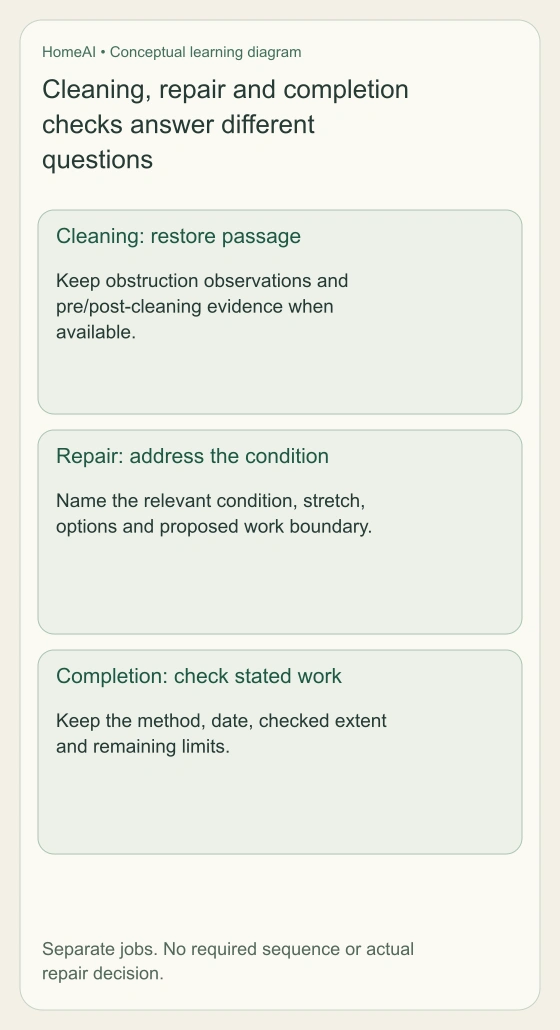
- Cleaning
Ask what was removed and what became visible afterwards.
- Repair
Ask which identified stretch and condition the work addresses.
- Completion evidence
Ask what was checked, by which method and over which part of the route.
What does this illustration leave out?
No actual obstruction, defect, suitable repair, completion finding, warranty or required sequence is supplied. Read the full explanation below; these are separate jobs, not a compulsory sequence.
Does the proposal distinguish restoring passage from addressing the entry route or pipe condition?
Explore this with HomeAI ↗Opens an editable question. Nothing is sent until you choose to send it.Read the complete diagram
Cleaning, repair and completion checks answer different questions
- Cleaning: restore passage
- Keep the obstruction observations and pre/post-cleaning evidence when available.
- Repair: address specified condition
- Name the relevant condition, stretch, options and proposed work boundary.
- Completion checks: document stated work
- Keep the method, date, checked extent and remaining limits. A completion record is evidence for its scope.
The three tasks are compared separately. Cleaning does not always require a repair, and a repair is not selected by this illustration.
What remains unknown: No actual obstruction, defect, suitable repair, completion finding, warranty or required sequence is supplied.
What should an owner do during a backup?
Keep people away from contaminated water and any wet electrical equipment. Avoid entering a flooded or sewage-affected basement to collect photographs. Use the current local utility response route and contact your insurer; Calgary directs residents with a sewage backup to 311 so the issue can be triaged between internal plumbing and City infrastructure. Elsewhere, start with the applicable utility’s published instructions.
Stop using affected plumbing and tell the responder which fixtures are involved, when the event started and whether other properties are affected, if known. Do not open manholes, enter sewers or tanks, or attempt powered clearing in an unsafe area. Confined-space and electrical hazards are separate from whether the obstruction itself looks simple.
After the immediate response, retain the service report, safe photographs, damaged-item information and professional restoration records. Ask the insurance representative specifically about sewer-backup damage, exclusions and the separate question of buried-line repair. IBC describes sewer-backup coverage as optional and policy-dependent; a standard policy label is not a coverage decision.
Keep learning about the connected parts
- Sewage ejectors: how a lower bathroom drains
- Leak sensors and automatic shutoff: understand detection, valve action and response
- Buying a home with a secondary suite: shared systems, records and responsibilities
- Trees beside a house: understand roots, canopy and the site before deciding
- Kitchen waste disposers: follow grinding, water and the receiving drain
Practice the distinction.
An older public pipe beside a recently repaired private line
Fictional Canadian learning scenario: a buyer sees an older municipal-segment record in a mature Calgary community, while the seller supplies an invoice for a private-side repair.
Reported observations
- The municipal dataset describes the City-owned section only.
- The invoice describes a specified private-side section, with no whole-route inspection conclusion.
- A short inspection recording ends before a confirmed municipal connection.
Compare the explanations
Expand each possibility to see the evidence needed to distinguish it. Similar symptoms can have different mechanisms.
Different ages along the route
A replaced private section can coexist with an older municipal section.
Location-specific work records and professional route identification.
Incomplete condition coverage
The remaining route has not been shown by the supplied recording.
A defined follow-up scope stating the endpoint and visibility limits.
A useful next question
Ask the provider to identify the inspected and repaired extents, preserve the unknown portion, and specify the evidence needed to answer the buyer’s actual question.
The scenario does not establish roots, pipe failure, repair liability or a reason to proceed with or cancel a purchase.
Know what the words mean.
- Sewer lateral
- The connecting pipe between the building drainage and municipal sewer. Local rules determine who owns and maintains each part.
- Building drain
- The drainage route collecting connected wastewater inside the building before it continues towards the building sewer.
- Trap seal
- Water retained in a trap to provide a barrier between the room and gases in the drainage system.
- Cleanout
- An opening provided for professional access to the drainage route; its location and the pipe it serves need identification.
- Offset joint
- A joint where the adjoining pipe ends do not line up. The observed extent and consequence require the provider’s explanation.
- Embedment
- The supporting material around a buried pipe. It is part of how a flexible pipe and the ground work together.
- Surcharge
- A raised level or pressure in the sewer that can push wastewater back towards connected homes.
- Inspection coverage
- The route and surfaces the inspection actually reached, including its start, end and visibility limits.
- Scope limitation
- A part, surface or question the stated inspection could not address. Keep that limit beside the findings.
Questions to bring
to the conversation.
- Where does each water route go, and which cleanout or device belongs to it?
- Which municipality’s boundary, access, permit and service rules apply?
- Does the recording actually reach the stated endpoint, and what remained unseen?
- Is a repair scope tied to an observed condition and followed by completion evidence?
Separate a showing observation, an existing record and a new professional assessment. Unknown means a question remains; it does not automatically mean a defect.
Use the evidence planner ↗Go to the source.
Original HomeAI explanation informed by these public references. Sources support the underlying guidance; they have not reviewed or endorsed HomeAI. Diagrams are conceptual, and calculator outputs depend on your inputs.
Publication & source review
First published .
Sources reviewed .
- City of Calgary · Wastewater treatment system
- City of Calgary · Installing water and sewer connections
- City of Calgary · Public Sanitary Service Lines
- City of Calgary · Community District Boundaries
- City of Calgary · 311 service request directory
- City of Calgary · Sewage backups
- City of Calgary · Problems with poplar trees
- City of Calgary · Flexible thermoplastic pipe standard practice
- City of Calgary · Water guidelines and construction specifications
- City of Calgary · Development Site Servicing Plans
- City of Winnipeg · Preventing sewer backup
- City of Winnipeg · Private sewer pipe responsibilities
- City of Toronto · Preventing basement flooding
- City of Toronto · Basement flooding protection subsidy program
- City of Ottawa · Protective plumbing questions
- IPEX · Canadian PVC sewer and drainage products
- IPEX · Canadian ABS drain, waste and vent product sheet
- Pinellas County · Orangeburg material explanation
- Government of Alberta · Hiring a home inspector
- Insurance Bureau of Canada · Water damage and flood protection
- CCOHS · Confined-space hazards
- Electrical Safety Authority · Flood safety
- NRC · National Plumbing Code of Canada 2025 (model code; local adoption must be confirmed)
Have a question about your home?
Start with the symptom, timing and what you have observed.
Ask HomeAI