Jump to a question in this guide
- 1. Start with three different questions
- 2. Establish which provincial rules actually apply
- 3. Turn the seller's story into an identifiable timeline
- 4. Read authorization and registry results as bounded evidence
- 5. Understand how a house becomes concealed
- 6. Connect drawings to the house that is actually for sale
- 7. Separate inspection events from a complete condition assessment
- 8. Identify the protection you would actually receive
- 9. Make services and handover information usable
- 10. Bring the lender and insurer the actual facts early
- 11. Compare realistic alternatives
- 12. A fictional purchase with two independent holds
- 13. Assemble a file that another professional can follow
- 14. Decide on the evidence you have
- Keep three purchase questions separate: authority to transact, physical construction evidence and the protection or recourse actually available.
- Use a construction and alteration timeline to connect drawings, concealed-stage evidence and inspection records to the house now for sale.
- A provincial authorization, a present condition report and a warranty or statutory obligation have different purposes; reconcile them with the lender, insurer and legal adviser.
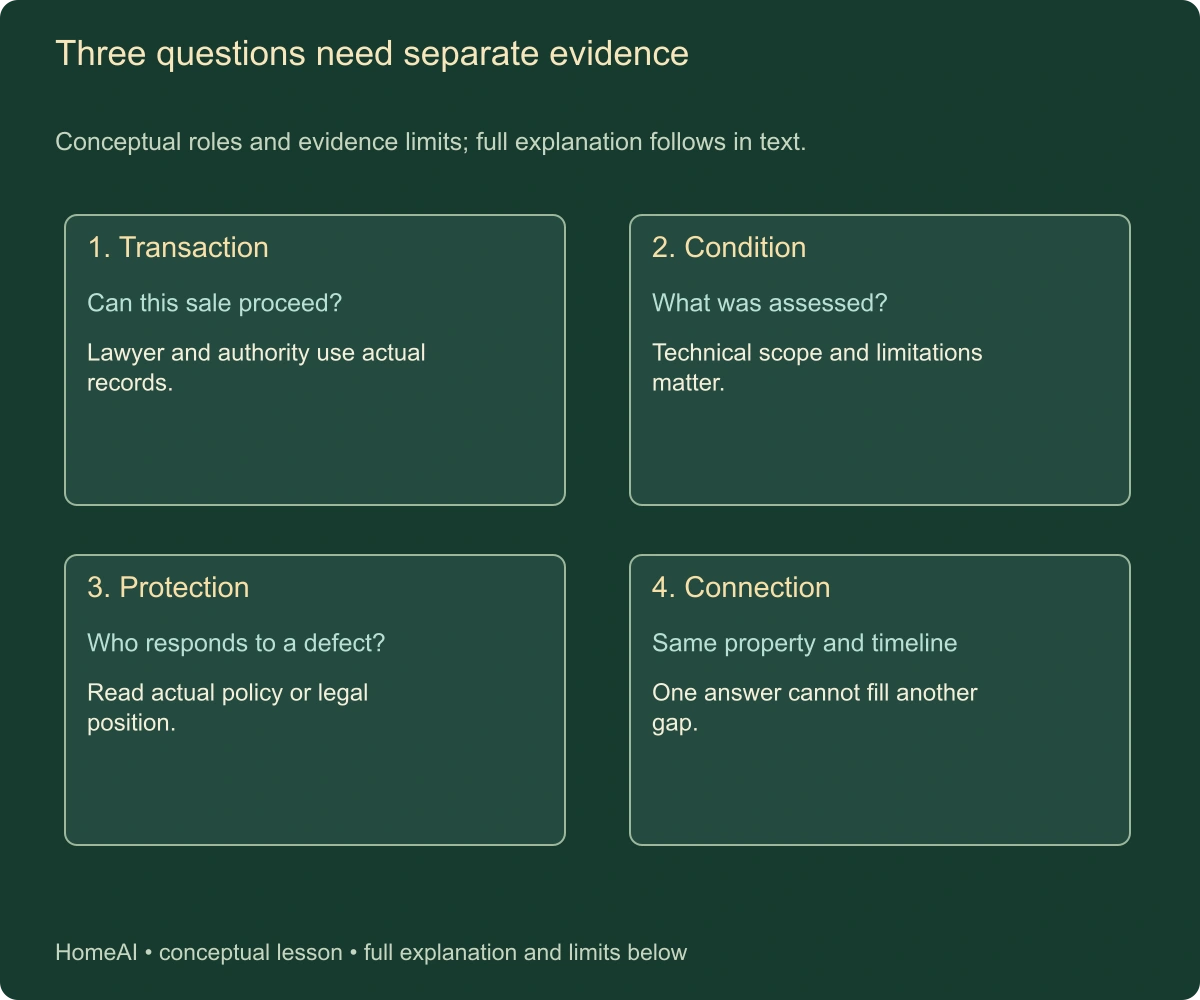
Authorization, physical condition and protection perform different jobs.
About this illustration
No sale permission, defect finding or legal remedy established. This is a conceptual teaching model, not an assessment of your home.
7 picture lessons appear beside the questions in this guide. Use them to understand the explanation, then consider what it means for your home.
1. Start with three different questions
An owner-built home can be a carefully managed personal project, a partly documented undertaking, or a house that has changed substantially since its original completion. The description tells you something about how the home was delivered. It does not tell you whether this sale is permitted, whether the construction is sound, or what protection you would receive. Those are three separate questions. A satisfactory answer to one cannot supply the missing answer to another.
Begin by identifying the property, its jurisdiction, its construction history and the seller's actual role. Ask what the seller means by owner-built. Did they obtain a formal owner-builder authorization, arrange trades under another delivery model, or simply perform later renovations themselves? Marketing language can combine these different situations. Your lawyer and the relevant regulator need the actual records before applying a provincial owner-builder regime to the transaction. A familiar-looking house does not settle its administrative history.
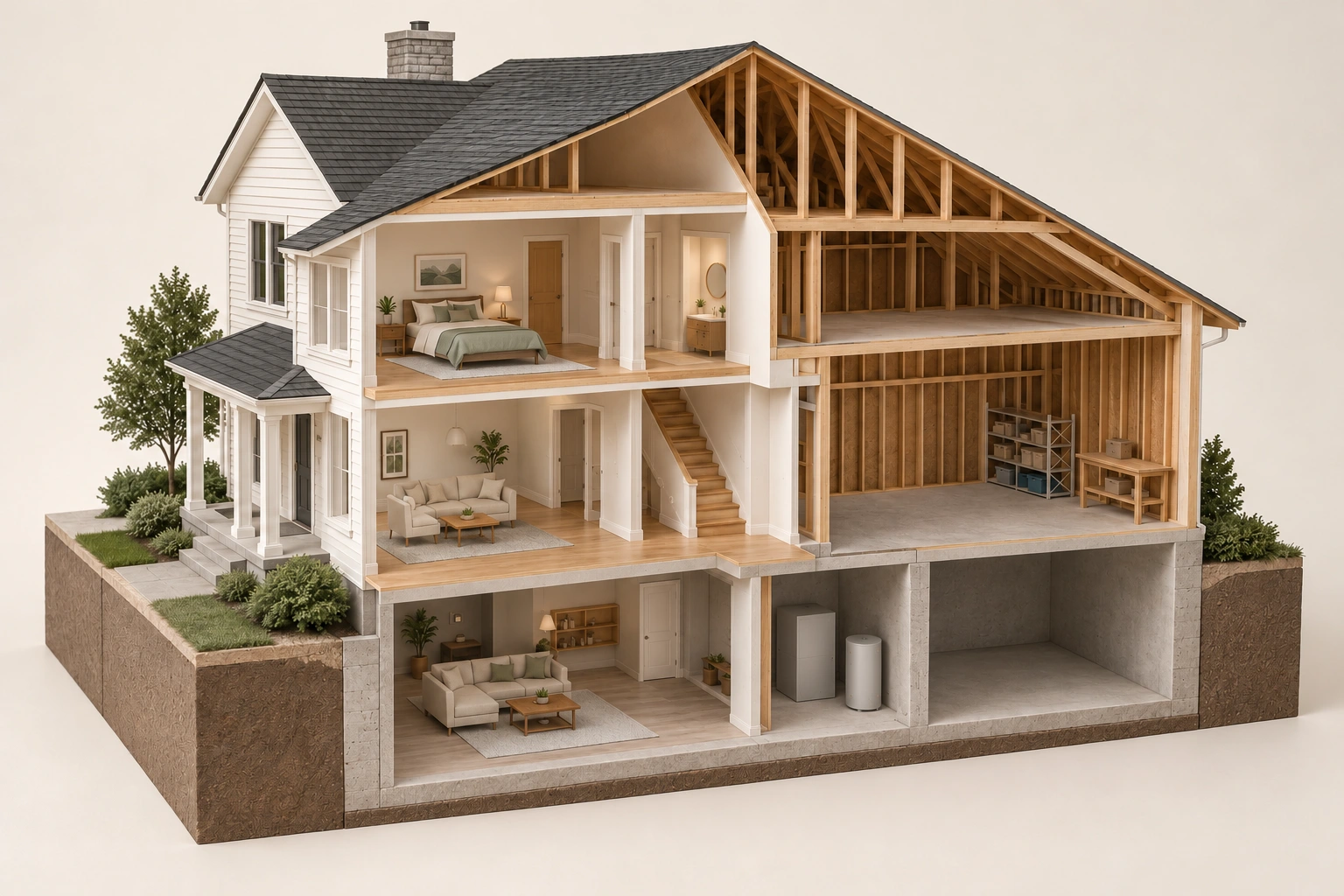
The whole-house cutaway puts finished rooms beside exposed framing and a basement. Its purpose is to connect the visible house to the construction sequence that produced it. You can see finishes during a viewing; the records may be your only available account of foundations, concealed connections and work before enclosure. This illustration is conceptual and contains no finding about an actual home's construction, services or approval.
Keep three columns in the purchase file: authority to transact, physical construction evidence, and protection or recourse. Put each document in the column it can actually support. A permit may identify authorized work without proving every concealed installation. A warranty document may describe coverage without confirming the current condition. A pleasing inspection may describe accessible areas without establishing that the seller can legally offer the home. Keeping the columns distinct makes omissions easier to see before they become closing problems.
Three questions need separate evidence
Authorization, physical condition and protection perform different jobs.
Numbers identify the parts explained below.
- Transaction
Can this sale proceed?. Lawyer and authority use actual records.
- Condition
What was assessed?. Technical scope and limitations matter.
- Protection
Who responds to a defect?. Read actual policy or legal position.
What does this illustration leave out?
No sale permission, defect finding or legal remedy established. This illustration explains an idea. It is not an installation guide.
Which actual records and competent assessment resolve this question?
Explore this with HomeAI ↗Opens an editable question. Nothing is sent until you choose to send it.What does the actual owner-builder history establish about this home
Finished rooms are the visible outcome of a construction sequence. The adjacent framing and basement remind the buyer to seek identifiable evidence for work before cover; the closed equipment forms establish no service design.
Numbers identify the parts explained below.
- Visible context
Finished rooms are the visible outcome of a construction sequence. The adjacent framing and basement remind the buyer to seek identifiable evidence for work before cover; the closed equipment forms establish no service design.
- Limit
Conceptual generated context. No actual property, installed design, topology, measured performance, approval, ownership or responsibility established.
What does this illustration leave out?
Conceptual generated context. No actual property, installed design, topology, measured performance, approval, ownership or responsibility established. This illustration explains an idea. It is not an installation guide.
What does the actual owner-builder history establish about this home?
Explore this with HomeAI ↗Opens an editable question. Nothing is sent until you choose to send it.Three questions need separate evidence
Conceptual roles and evidence limits; full explanation follows in text.
- Transaction
- Can this sale proceed?. Lawyer and authority use actual records.
- Condition
- What was assessed?. Technical scope and limitations matter.
- Protection
- Who responds to a defect?. Read actual policy or legal position.
- Connection
- Same property and timeline. One answer cannot fill another gap.
Authorization, physical condition and protection perform different jobs.
What remains unknown: No sale permission, defect finding or legal remedy established.
A useful question: Which actual records and competent assessment resolve this question?
What does the actual owner-builder history establish about this home
Finished rooms are the visible outcome of a construction sequence. The adjacent framing and basement remind the buyer to seek identifiable evidence for work before cover; the closed equipment forms establish no service design.
What remains unknown: Conceptual generated context. No actual property, installed design, topology, measured performance, approval, ownership or responsibility established.
A useful question: What does the actual owner-builder history establish about this home?
2. Establish which provincial rules actually apply
Owner-builder arrangements are jurisdiction specific. The Alberta government page read for this guide describes an authorization for single-family, site-built homes intended for the owner's personal use. It distinguishes authorization from builder licensing and discusses the owner's choice about warranty coverage. It also describes restrictions on offering or selling without the required coverage during the applicable protection period. These statements belong to that Alberta regime; they are not a Canadian definition that you can apply unchanged to another province or an older project.
The same Alberta page describes a caveat transition for authorizations issued without warranty on or after December 1, 2025. That date matters because absence of a recently introduced title notice is not proof that an earlier home has warranty or unrestricted sale status. Ask your lawyer to reconcile the title, authorization, registry information, occupancy history and current regulator response. Do not infer eligibility from one missing notation or a seller's estimate of the home's age.
BC Housing's current buying-and-selling page describes its own occupancy, disclosure and permission requirements, together with a registry route for checking a home's recorded status. It distinguishes owner-builder statutory liability from a third-party warranty insurance policy. Those BC concepts should not be silently substituted for Alberta's process. A buyer crossing a provincial boundary needs a fresh legal and administrative assessment, even when both listings use the same owner-built label.
The retained BC bulletin is visibly dated January 2016. It is useful historical context for the way authorization, disclosure and statutory protection were explained, but it is not the basis for declaring today's transaction lawful. The current served pages were read October 14, 2026; their actual applicability still depends on the property's dates and facts. This guide deliberately leaves statutory calculations, exemptions and transaction wording to the lawyer and authority working with those records.
3. Turn the seller's story into an identifiable timeline
A construction timeline is more useful than a general assurance that everything was inspected. Start with land ownership and authorization, then identify permit issuance, major construction stages, inspections, initial occupancy, final municipal documentation and later alterations. Where dates disagree, retain both versions and ask who can resolve the difference. The date written on an invoice may concern delivery or payment rather than installation, and a photograph's upload date may differ from when the work occurred.
Ask the seller which portions they personally performed, which they managed and which specialists or trades completed. The distinction helps locate records and competent people to answer technical questions. Owner-built does not mean every task was performed by an untrained owner, and a professional invoice does not prove that the invoiced scope covered the whole house. A contractor may have completed only a foundation, rough-in or particular repair. Match the named scope to the actual part of the building.
Record unfinished items separately from alleged defects. A missing finish, an incomplete drainage detail and an unresolved structural question have different implications, even if they all appear on one punch list. Ask whether the home was occupied before all work was completed and what documents record the outstanding conditions. Your adviser needs to know whether the transaction concerns a completed home with later maintenance, a phased project or a substantially unfinished building.
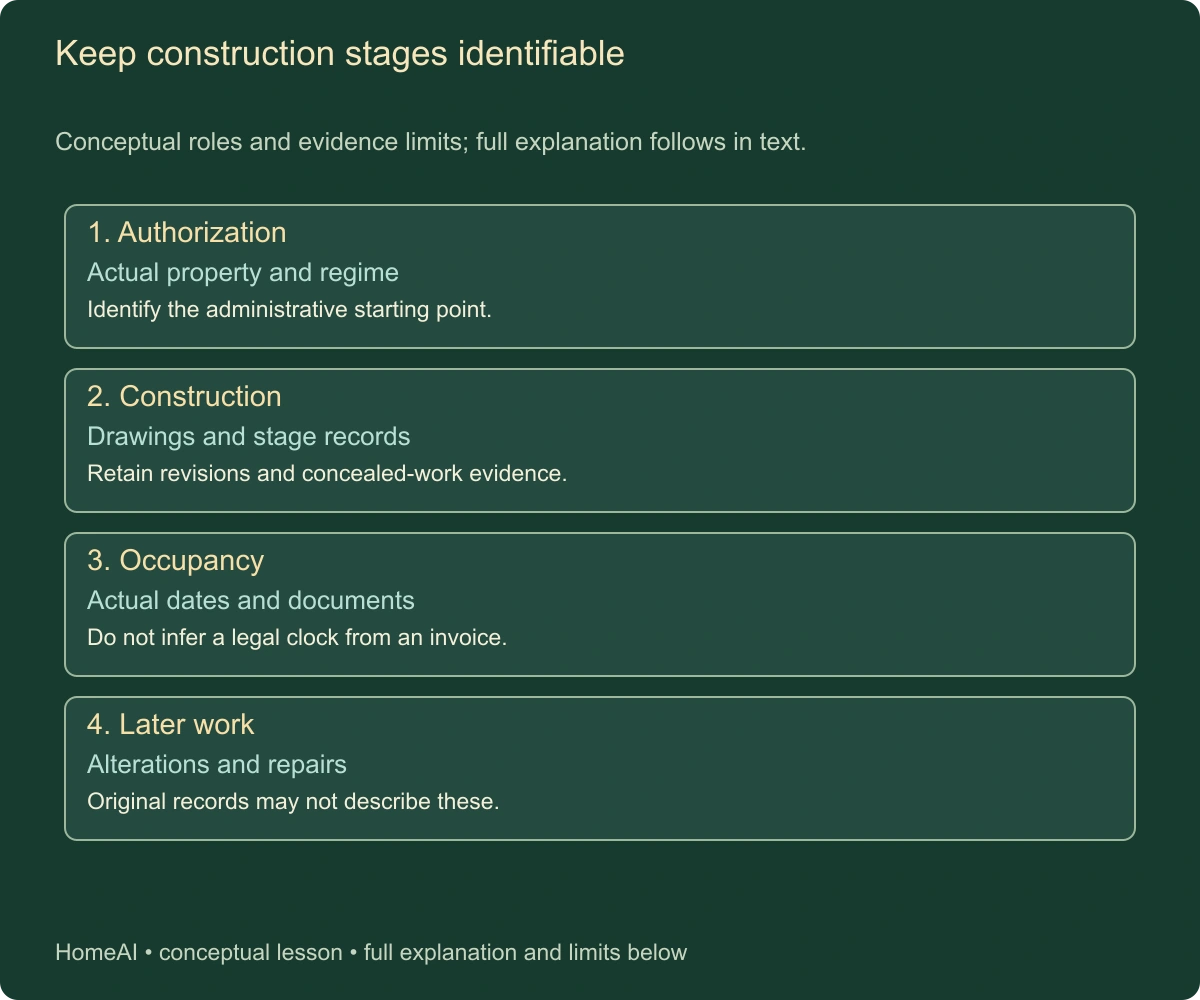
Use the timeline to direct the inspection rather than to award the house a score. If windows were changed after the envelope inspection, the earlier inspection cannot describe those later interfaces. If a basement was finished years after initial occupancy, original drawings may show neither its partitions nor its services. Chronology reveals where the documentary chain ends and a new investigation begins. That is more actionable than a thick folder arranged only by document type.
Keep construction stages identifiable
Chronology identifies where an earlier record stops describing the present house.
Numbers identify the parts explained below.
- Authorization
Actual property and regime. Identify the administrative starting point.
- Construction
Drawings and stage records. Retain revisions and concealed-work evidence.
- Occupancy
Actual dates and documents. Do not infer a legal clock from an invoice.
What does this illustration leave out?
No universal statutory period or completed stage. This illustration explains an idea. It is not an installation guide.
Which actual records and competent assessment resolve this question?
Explore this with HomeAI ↗Opens an editable question. Nothing is sent until you choose to send it.Keep construction stages identifiable
Conceptual roles and evidence limits; full explanation follows in text.
- Authorization
- Actual property and regime. Identify the administrative starting point.
- Construction
- Drawings and stage records. Retain revisions and concealed-work evidence.
- Occupancy
- Actual dates and documents. Do not infer a legal clock from an invoice.
- Later work
- Alterations and repairs. Original records may not describe these.
Chronology identifies where an earlier record stops describing the present house.
What remains unknown: No universal statutory period or completed stage.
A useful question: Which actual records and competent assessment resolve this question?
4. Read authorization and registry results as bounded evidence
An authorization is evidence of a particular administrative status under a particular program. It is not a certificate that every component was correctly built or that the person selling today has satisfied every requirement affecting this sale. Obtain the identifiable authorization and have the regulator or lawyer confirm that it belongs to the property and delivery history under discussion. A screenshot without an address, reference or date may be difficult to reconcile with the rest of the file.
Registry searches can help identify recorded builder, warranty or exemption information. BC Housing's current page describes its New Homes Registry as a route to checking whether a home has warranty insurance or an exemption such as owner-builder authorization, and whether a disclosure notice is on file. It also describes limits relating to older registration periods and offers a direct inquiry route. A missing search result therefore becomes a question for the authority, rather than automatic proof that the home is unregistered or unrestricted.
Keep the search date and the actual result. A status captured when the seller first investigated the project may not answer a buyer's question immediately before an agreement or closing. Ask whether a permission document has conditions, whether those conditions have been met, and whether further confirmation is needed for the proposed transaction. Your lawyer should determine the appropriate sequence. A purchase condition cannot be assumed to cure an offer that the applicable regime does not permit in the first place.
The comparison keeps transaction status, assessed condition and actual protection separate, while connecting them to the same property and timeline. None should point automatically to the next as though one creates the other. The useful relationship is documentary: each record answers a different question, and conflicts require resolution. This prevents a buyer from treating an administrative green light as a substitute for an inspection, or treating an excellent inspection as permission to proceed with an otherwise unresolved sale.
5. Understand how a house becomes concealed
Construction creates a sequence of opportunities to observe work. Excavation and foundation work precede framing; services and insulation can become hidden behind finishes; exterior interfaces can disappear behind cladding. A finished house presents the result of that sequence, but a conventional viewing cannot recreate all of its earlier stages. That is why contemporaneous drawings, inspection records and identifiable photographs can be valuable when the owner was also coordinating the project.
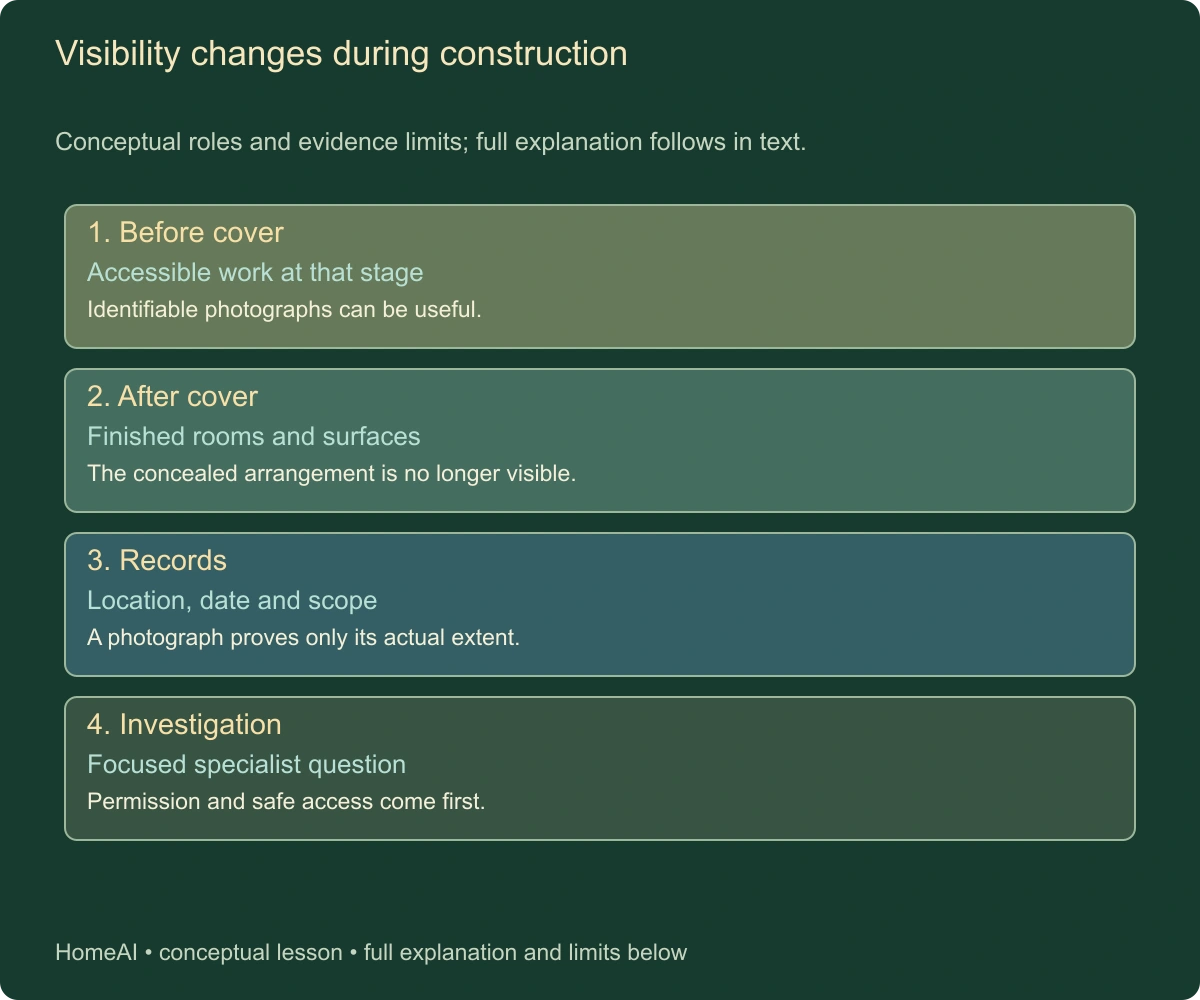
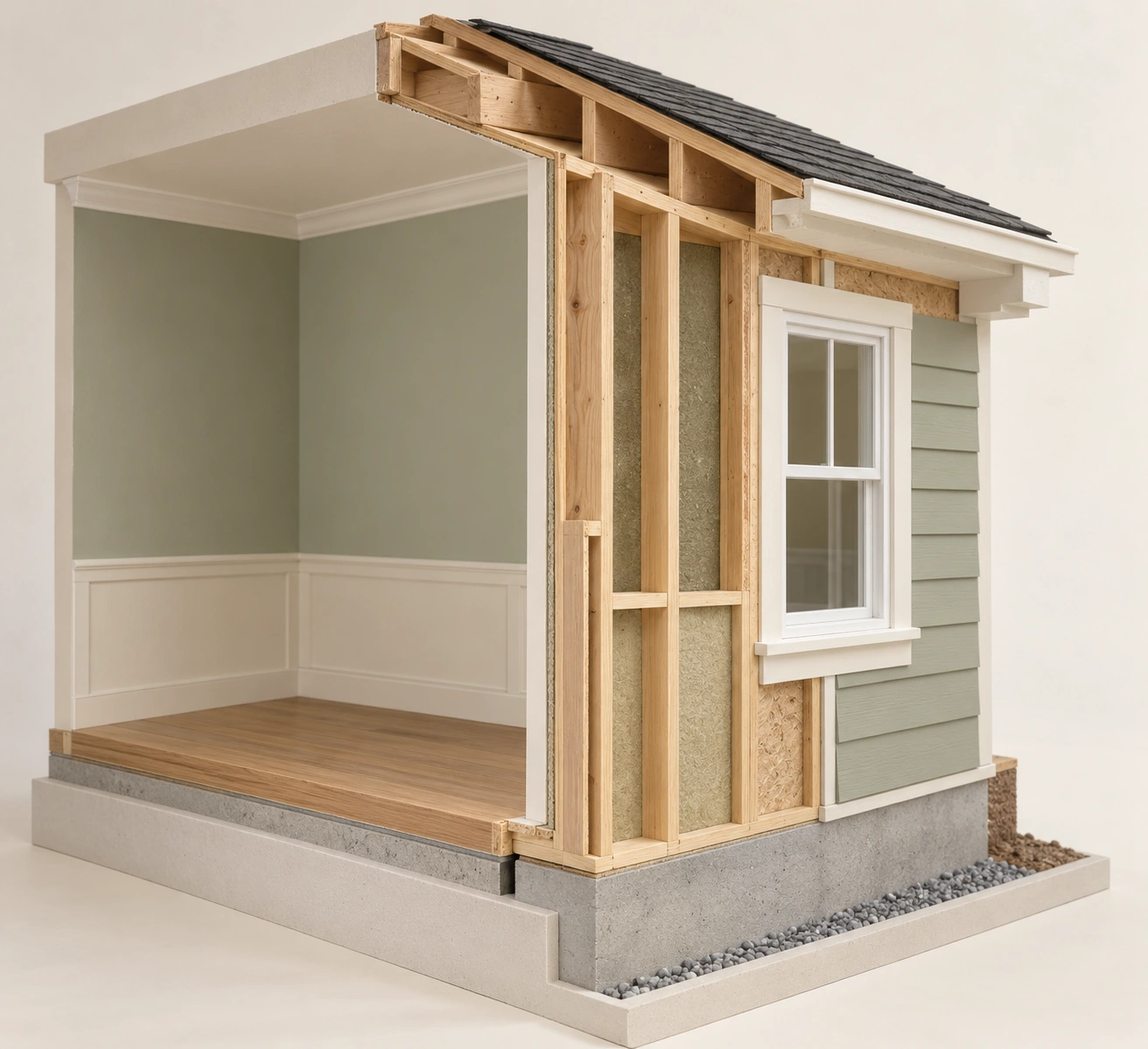
The wall cutaway shows a finished surface next to open framing and insulation. It illustrates loss of visibility, rather than a recommended wall design. The buyer's question is what evidence exists for the work before it was covered and whether that evidence relates to this location. A close photograph of insulation does not establish the whole wall's moisture control, structural connections or continuity around openings. Nor does an exposed corner show what is behind every finished room.
Ask your inspector to explain the accessible scope, the concealed areas and any observations that justify a specialist referral. A referral should name the question: a load path, a water-entry interface, a foundation movement pattern or a particular service installation. Vague requests to certify the whole house can produce vague responses or an unmanageable scope. A focused question lets the specialist explain what can be assessed from records and access, what requires further permission and what remains uncertain.
Do not remove finishes, open electrical equipment, enter unsafe spaces or disturb suspect materials to make the purchase file more complete. Any intrusive investigation requires the owner's permission and a competent plan for safe access, protection and reinstatement. The value of an answer depends partly on how it was obtained. If adequate access is unavailable before the decision, record the limitation and decide whether the remaining uncertainty fits your circumstances rather than pretending the missing evidence exists.
Visibility changes during construction
Finished appearance and contemporaneous evidence answer different questions about concealed work.
Numbers identify the parts explained below.
- Before cover
Accessible work at that stage. Identifiable photographs can be useful.
- After cover
Finished rooms and surfaces. The concealed arrangement is no longer visible.
- Records
Location, date and scope. A photograph proves only its actual extent.
What does this illustration leave out?
No whole-house certification or permission for intrusive access. This illustration explains an idea. It is not an installation guide.
Which actual records and competent assessment resolve this question?
Explore this with HomeAI ↗Opens an editable question. Nothing is sent until you choose to send it.Which concealed stages have property-specific records
Covering a wall changes what can be observed. The finish and open framing illustrate why location-specific construction records can help, while leaving the actual concealed installation unverified.
Numbers identify the parts explained below.
- Visible context
Covering a wall changes what can be observed. The finish and open framing illustrate why location-specific construction records can help, while leaving the actual concealed installation unverified.
- Limit
Conceptual generated context. No actual property, installed design, topology, measured performance, approval, ownership or responsibility established.
What does this illustration leave out?
Conceptual generated context. No actual property, installed design, topology, measured performance, approval, ownership or responsibility established. This illustration explains an idea. It is not an installation guide.
Which concealed stages have property-specific records?
Explore this with HomeAI ↗Opens an editable question. Nothing is sent until you choose to send it.Visibility changes during construction
Conceptual roles and evidence limits; full explanation follows in text.
- Before cover
- Accessible work at that stage. Identifiable photographs can be useful.
- After cover
- Finished rooms and surfaces. The concealed arrangement is no longer visible.
- Records
- Location, date and scope. A photograph proves only its actual extent.
- Investigation
- Focused specialist question. Permission and safe access come first.
Finished appearance and contemporaneous evidence answer different questions about concealed work.
What remains unknown: No whole-house certification or permission for intrusive access.
A useful question: Which actual records and competent assessment resolve this question?
Which concealed stages have property-specific records
Covering a wall changes what can be observed. The finish and open framing illustrate why location-specific construction records can help, while leaving the actual concealed installation unverified.
What remains unknown: Conceptual generated context. No actual property, installed design, topology, measured performance, approval, ownership or responsibility established.
A useful question: Which concealed stages have property-specific records?
6. Connect drawings to the house that is actually for sale
Drawings can describe intended construction, revisions or a recorded completed arrangement. Ask which kind you have. A permit set is especially useful for locating planned walls, foundations, openings and services, but it may not incorporate every change made during construction. Look for revision references and the accompanying approvals or professional correspondence. A clean drawing title does not establish that the house was built precisely as shown.
Compare the basic arrangement with what can be safely observed: levels, major openings, stairs, additions and occupied areas. The purpose is to identify discrepancies for the appropriate adviser, not to perform a lay structural review. A doorway in a different position might be an authorized revision, an inaccurate record or a consequential alteration. The buyer needs the explanation and supporting evidence before deciding which interpretation is reasonable.
Engineering documents also have defined scopes. A foundation design does not necessarily address later floor openings; a site visit letter may concern only the work visible that day. Ask the engineer or your own adviser what the document actually concludes, what it assumes and whether it remains relevant to the current configuration. Avoid converting a professional's limited statement into a whole-house approval through a seller's summary or a listing description.
Where the file contains several versions, preserve the sequence instead of replacing older sheets with the newest-looking set. A revision history can explain how a change was handled and whether dependent work was reconsidered. Missing final drawings do not automatically prove defective construction, but they can increase the effort needed to understand concealed or altered work. Include that investigation in the purchase decision rather than treating record collection as an administrative task to finish after closing.
A useful drawing enquiry names the discrepancy and the dependent work. If an opening differs from the permit set, ask whether a revision exists and which professional can explain its structural and enclosure consequences. This is more productive than collecting every available sheet without identifying the question. The adviser can then say whether the supplied material addresses that discrepancy or whether further investigation is needed.
Keep correspondence with the drawings it interprets. A brief letter can qualify a much larger plan set, while a later sketch can change only one identified location. Read them together and preserve their dates. The buyer should be able to follow why an adviser regarded a particular arrangement as supported, rather than relying on a folder title such as final plans.
7. Separate inspection events from a complete condition assessment
Municipal and trade inspection records can identify stages reviewed, results recorded and conditions requiring follow-up. Read the actual entries. A record marked passed may relate to a specific stage or scope, while another item remains outstanding. Ask the authority what the record means and whether the permit file is complete for the use and construction now present. The inspector's institutional role and the buyer's private condition assessment serve different purposes.
A home inspection normally concerns accessible conditions within the agreed scope on the inspection date. It can reveal maintenance needs and observations that deserve further investigation. It does not recreate every construction inspection, uncover every concealed condition or determine all legal rights under an owner-builder program. Ask for the report's limitations before relying on a brief verbal conclusion that the house looks well built.
When a specialist report is supplied by the seller, confirm its property identification, date, author, scope and availability for reliance by you. Your adviser can explain whether clarification or a new assessment is appropriate. A report obtained before repairs may identify the original problem without documenting the completed remedy. A repair invoice may describe work performed without independently demonstrating that the underlying cause was addressed.
Organize observations by consequence and next decision. Some require routine maintenance planning; some affect insurability, financing or lawful use; others may justify pausing until a technical question is answered. Avoid reducing the report to a defect count. One unresolved envelope or structural issue may matter more to your household and budget than numerous cosmetic items. The useful output is a clear statement of what is understood, what action is proposed and what uncertainty would remain after that action.
8. Identify the protection you would actually receive
Warranty insurance, statutory obligations, contractual promises and a seller's willingness to help are different sources of protection. Ask for the actual policy or disclosure documents and have your lawyer explain who is responsible, what is covered, how timing is determined and what process applies. Do not treat an owner's statement that they stand behind their work as equivalent to an insurer-backed policy.
BC Housing's current page expressly distinguishes owner-builder statutory protection from third-party warranty insurance and explains that purchasers may need to pursue the owner builder directly. That distinction affects the practical work of seeking a remedy. A legal right does not tell you how quickly a dispute will be resolved, whether the responsible person has resources or how much professional effort a claim might require. Your lawyer can assess those issues for the particular file without promising a result.
Alberta's current owner-builder page explains that obtaining warranty after construction or occupancy may be difficult, expensive or unavailable. A seller's plan to buy coverage later therefore needs actual confirmation from the relevant provider and the legal adviser before it becomes a premise of the purchase. Do not budget or schedule closing on the assumption that a policy will inevitably be issued.
Protection also has limits when the buyer changes the house. Proposed alterations may introduce new work, interfaces or responsibilities beyond an original policy or assessment. Ask the relevant professional how your plan interacts with the documents you are relying on. This is particularly useful when a buyer intends immediate basement completion, wall removal or a major mechanical change. The protection question should describe the home you are purchasing and the work you actually intend, rather than an abstract promise of coverage.
A promise and a policy are different
BC’s stated statutory model and Alberta’s warranty questions remain jurisdiction specific.
Numbers identify the parts explained below.
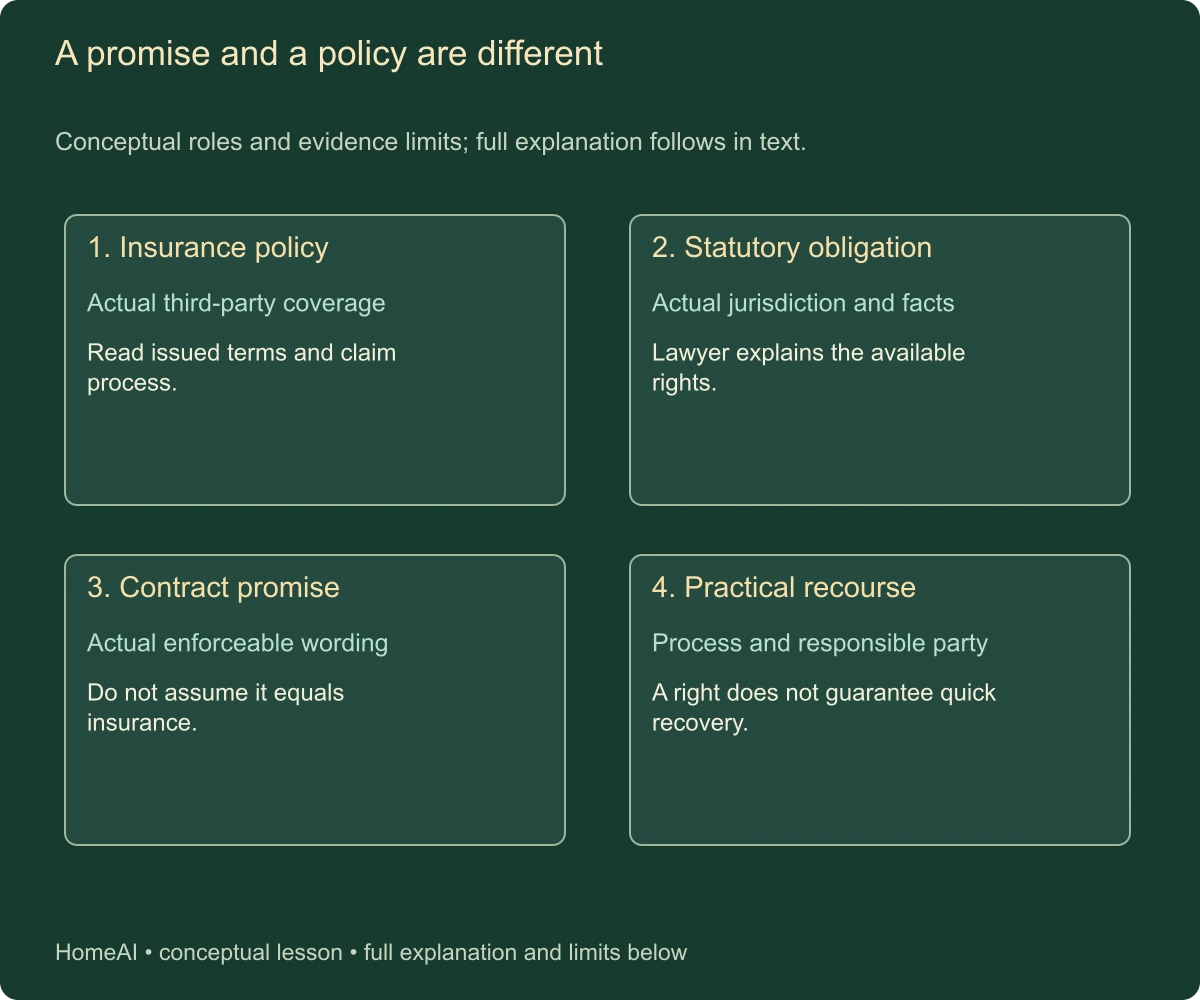
- Insurance policy
Actual third-party coverage. Read issued terms and claim process.
- Statutory obligation
Actual jurisdiction and facts. Lawyer explains the available rights.
- Contract promise
Actual enforceable wording. Do not assume it equals insurance.
What does this illustration leave out?
No entitlement, collectability, deadline or remedy advice. This illustration explains an idea. It is not an installation guide.
Which actual records and competent assessment resolve this question?
Explore this with HomeAI ↗Opens an editable question. Nothing is sent until you choose to send it.A promise and a policy are different
Conceptual roles and evidence limits; full explanation follows in text.
- Insurance policy
- Actual third-party coverage. Read issued terms and claim process.
- Statutory obligation
- Actual jurisdiction and facts. Lawyer explains the available rights.
- Contract promise
- Actual enforceable wording. Do not assume it equals insurance.
- Practical recourse
- Process and responsible party. A right does not guarantee quick recovery.
BC’s stated statutory model and Alberta’s warranty questions remain jurisdiction specific.
What remains unknown: No entitlement, collectability, deadline or remedy advice.
A useful question: Which actual records and competent assessment resolve this question?
9. Make services and handover information usable
An owner who coordinated construction may hold much of the practical knowledge in memory. Ask for a written handover that identifies installed equipment, controls, isolation arrangements, service providers and maintenance requirements without expecting the seller to become your permanent technical support. The purpose is to make the home understandable to future occupants and qualified service people after the owner is no longer available.
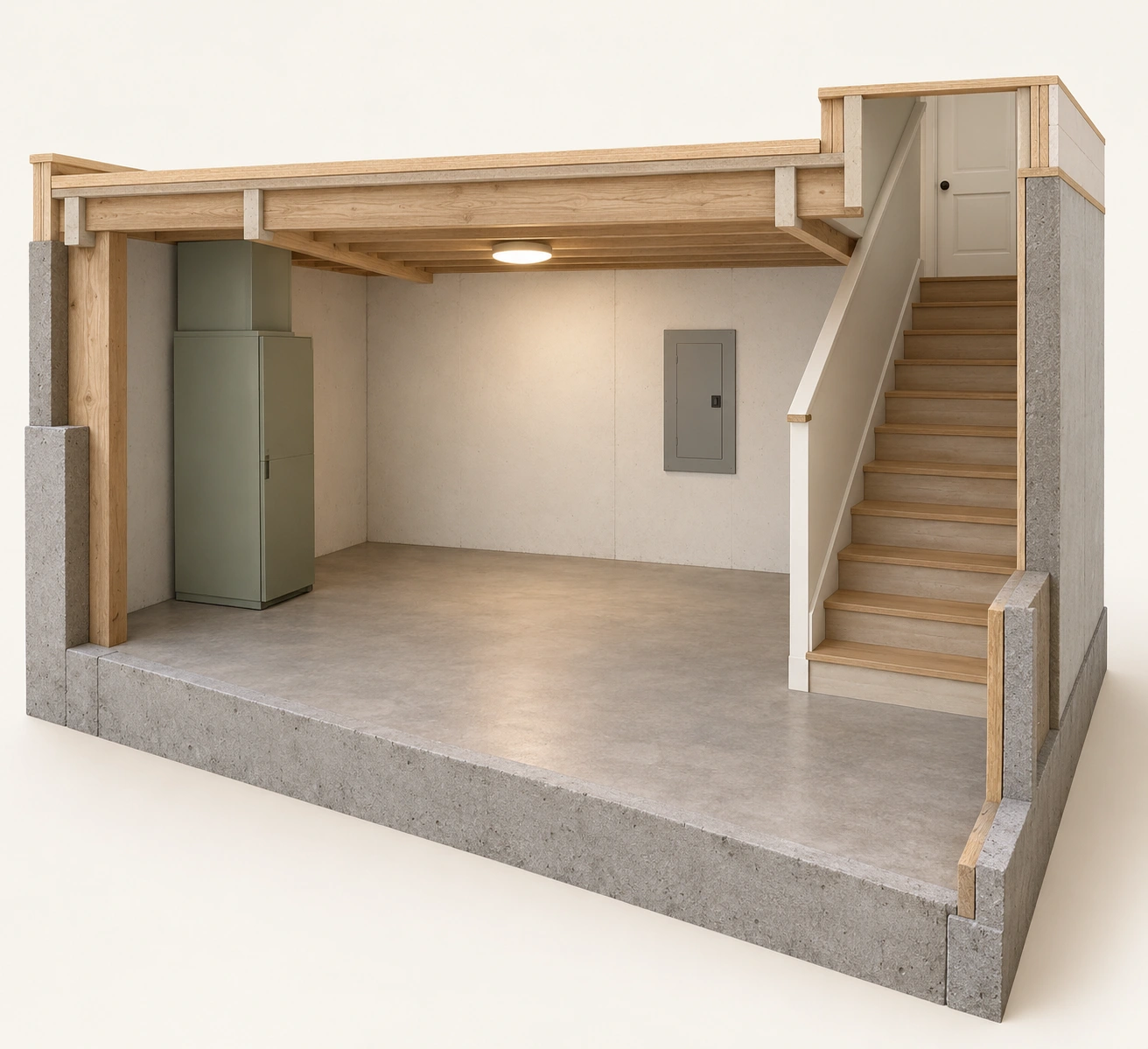
The basement context shows closed equipment forms, a closed electrical panel and a stair. It illustrates how several systems occupy the same service area, while deliberately leaving their internal connections unshown. A buyer can record labels from a safe position and request manuals; the picture does not prove equipment sizing, venting, electrical capacity or compliance. Those questions require the relevant trade and the actual installation information.
For each significant system, distinguish product identification, installation evidence and operating guidance. A manual explains a model's intended operation; an invoice may identify who supplied or installed it; commissioning or service records may document particular checks. None automatically substitutes for the others. Ask whether the provided records match the equipment now present, especially where replacements occurred after the original construction file was assembled.
A demonstration can help locate normal controls and explain everyday operation, but it is not a complete performance test. Ask a qualified person about unfamiliar systems and any inspection recommendation. Keep emergency and maintenance information accessible to the household rather than buried in the conveyancing file. A usable handover reduces avoidable confusion; it does not erase unresolved technical findings or supply missing legal permission.
Ask the seller to distinguish routine operation from service work. Locating a normal thermostat or shutoff in a handover is different from opening equipment, adjusting combustion or testing protective devices. A qualified service person should address technical uncertainties. The household needs a practical operating explanation that stays within safe everyday use rather than a hurried demonstration of work the buyer should not repeat.
Include later replacements in the equipment index. A construction-era manual may no longer match the appliance, pump or control now installed. Model information, installation dates and the scope of service records help future trades identify what they are working on. If information is missing, record the gap and obtain appropriate advice instead of assuming the oldest binder describes the present installation.
Which actual systems have separate installation and handover evidence
A service area brings several operating systems into one place. Closed equipment and panel faces help locate handover questions, but do not show connections, capacity, venting or commissioning.
Numbers identify the parts explained below.
- Visible context
A service area brings several operating systems into one place. Closed equipment and panel faces help locate handover questions, but do not show connections, capacity, venting or commissioning.
- Limit
Conceptual generated context. No actual property, installed design, topology, measured performance, approval, ownership or responsibility established.
What does this illustration leave out?
Conceptual generated context. No actual property, installed design, topology, measured performance, approval, ownership or responsibility established. This illustration explains an idea. It is not an installation guide.
Which actual systems have separate installation and handover evidence?
Explore this with HomeAI ↗Opens an editable question. Nothing is sent until you choose to send it.Which actual systems have separate installation and handover evidence
A service area brings several operating systems into one place. Closed equipment and panel faces help locate handover questions, but do not show connections, capacity, venting or commissioning.
What remains unknown: Conceptual generated context. No actual property, installed design, topology, measured performance, approval, ownership or responsibility established.
A useful question: Which actual systems have separate installation and handover evidence?
10. Bring the lender and insurer the actual facts early
Financing and insurance decisions can depend on the construction history, completion status, protection arrangements and outstanding work. Give each provider accurate documents and ask what written confirmation they require. A preliminary conversation based only on a listing description may not remain valid once the actual owner-builder status or an unresolved condition becomes known. Coordinate timing with your purchase adviser so the necessary review happens before you make an irreversible commitment.
Ask whether an unfinished area, missing documentation or proposed repair changes the provider's decision or introduces conditions. Record who will complete the work, when evidence is required and whether the proposed sequence is compatible with possession. A buyer should not assume they can finish an unresolved item after closing if the lender or insurer needs it addressed beforehand.
Separate the purchase price from the total resources needed to proceed. Include technical and legal review, defined remedial work, temporary accommodation if relevant, and a reserve for remaining uncertainty. A seller's material receipts are not a current replacement estimate, and a general construction allowance may omit access, design, permits, reinstatement or dependencies. Ask for scoped estimates that describe their exclusions rather than relying on a reassuring round number.
If a provider declines, understand the reason before treating another provider's willingness as a technical clearance. Different commercial criteria can produce different decisions about the same house. Conversely, a provider's acceptance does not mean every construction question has been investigated. Keep commercial acceptance in its own part of the file alongside the authority and condition evidence.
11. Compare realistic alternatives
The relevant alternatives may include proceeding with a well-supported file, obtaining targeted further investigation, asking the seller to resolve a defined issue before closing, renegotiating around a bounded obligation, or choosing another home. Each option needs a clear scope and a decision point. Asking for more documents indefinitely can consume time without resolving the question that matters.
A proposed seller repair should specify the problem being addressed, the competent person responsible and the evidence needed to assess completion. A cosmetic repair can improve appearance without answering the cause of movement or water entry. Your technical adviser should explain what completion evidence is meaningful, while your lawyer handles the agreement. Do not assume a holdback or promise is enforceable or sufficient simply because it appears practical.
For a buyer-led repair after possession, determine whether the work is actually feasible and compatible with occupancy, approvals, financing and insurance. A price reduction helps only if the remaining work and uncertainty fit the buyer's resources and circumstances. It cannot by itself create authorization, specialist availability or a remedy for an unidentified concealed problem.
Choosing another property can be a rational result even when no one has proven this house defective. A buyer may need a predictable move-in date, a simpler protection arrangement or less investigative work. The aim is an informed choice, not proving an owner-built home good or bad as a category. Compare actual evidence and practical consequences rather than the prestige or stigma attached to the delivery method.
12. A fictional purchase with two independent holds
Maya and Joel are considering a fictional owner-built house. The seller provides an authorization reference, a permit folder, photographs of framing and a binder of equipment manuals. Their first inspection finds an accessible area worth further envelope review. Their lawyer also needs to reconcile the occupancy history with the applicable sale requirements. These are separate holds: the technical referral cannot settle the sale status, and the regulator's response cannot assess the envelope.
The buyers ask the envelope specialist a focused question about the observed interface and the relevant construction photographs. The specialist explains which locations were accessible, what the photographs can support and what further access would be needed. The seller agrees to a limited investigation through an appropriate professional process. The buyers retain the scope and limitations rather than translating the visit into a whole-house certification.
Meanwhile, the lawyer obtains the property-specific administrative documents and explains the available protection. The original binder contains an assurance that warranty could be arranged later, but no issued policy. Maya and Joel do not count that assurance as existing coverage. They ask for the actual provider decision and consider the alternative legal position with their lawyer before deciding whether the transaction can proceed.
Their fictional budget includes $18,000 for a defined remedial scope and $7,000 of additional reserve. These figures illustrate bookkeeping, not market prices or a safe contingency percentage. The reserve does not cap the cost of an unidentified defect. If the investigation leaves a consequential uncertainty outside their capacity, they can step away even though they have already paid for advice. The useful outcome is a decision based on the remaining exposure, not a determination to justify sunk costs.
13. Assemble a file that another professional can follow
Create an index with the property identifier, jurisdiction, timeline, authorization and registry references, title information supplied through the lawyer, permits, drawings, reports, protection documents and handover records. Preserve original files and note the dates of later confirmations. A short index makes a large folder usable without implying that the quantity of paper proves quality.
For each unresolved question, name the person or authority who can answer it, the evidence requested and the point at which the buyer needs the answer. Distinguish an unanswered question from a negative finding. If a document is unavailable, record that absence and its consequence rather than substituting a verbal recollection. This makes it easier for advisers to explain the limits of their conclusions.
Keep repair and investigation records tied to locations. A photograph labelled only final inspection is less useful than one whose room, elevation or construction stage can be identified. Where the relationship cannot be established, mark it uncertain. Do not edit an original image or report to make it appear more conclusive; retain your explanatory notes separately.
At handover, transfer the practical operating file as well as the transaction archive. Future service people need equipment and maintenance information; a future sale may require the administrative history again. The file will not prevent every defect or guarantee a remedy. Its value is a traceable account of what was known, what was checked and what remained limited when the purchase decision was made.
14. Decide on the evidence you have
Before proceeding, be able to state three answers in plain language. The lawyer and authority have addressed the property's transaction status; the technical advisers have described the assessed condition and remaining limitations; the buyer understands the actual protection and practical recourse. If an answer depends on a future event, identify that event and the agreed decision sequence rather than calling the question resolved.
An owner-built label can invite either unwarranted confidence in personal craftsmanship or unwarranted suspicion of every hidden detail. Neither helps a buyer assess a particular house. The stronger approach follows the same building from authorization and construction through occupancy, later changes and current condition, using people whose responsibilities match the question.
Carry the remaining limitations into the ownership plan. A report may recommend monitoring, maintenance or specialist work that continues after closing. Assign those tasks and keep the supporting records available. If a critical limitation cannot fit your budget, timetable or tolerance for uncertainty, the purchase decision should reflect that before possession.
The goal is a home whose legal position, physical evidence and protection arrangements you can explain without relying on the seller's continued presence. That explanation may support a purchase, a further investigation or a decision to choose elsewhere. Each is a useful result when it follows the actual file rather than the label on the listing.
Keep learning about the connected parts
- A new home needs a technical handover
- Renovation records: what was proposed, approved and built?
- New-build commissioning: ask how the systems were verified
Canadian context and authorities · Visual atlas · Learning labs
Practice the distinction.
12. A fictional purchase with two independent holds
Maya and Joel are considering a fictional owner-built house. The seller provides an authorization reference, a permit folder, photographs of framing and a binder of equipment manuals. Their first inspection finds an accessible area worth further envelope review. Their lawyer also needs to reconcile the occupancy history with the applicable sale requirements. These are separate holds: the technical referral cannot settle the sale status, and the regulator's response cannot assess the envelope.
Reported observations
- The buyers ask the envelope specialist a focused question about the observed interface and the relevant construction photographs. The specialist explains which locations were accessible, what the photographs can support and what further access would be needed. The seller agrees to a limited investigation through an appropriate professional process. The buyers retain the scope and limitations rather than translating the visit into a whole-house certification.
- Meanwhile, the lawyer obtains the property-specific administrative documents and explains the available protection. The original binder contains an assurance that warranty could be arranged later, but no issued policy. Maya and Joel do not count that assurance as existing coverage. They ask for the actual provider decision and consider the alternative legal position with their lawyer before deciding whether the transaction can proceed.
A useful next question
Their fictional budget includes $18,000 for a defined remedial scope and $7,000 of additional reserve. These figures illustrate bookkeeping, not market prices or a safe contingency percentage. The reserve does not cap the cost of an unidentified defect. If the investigation leaves a consequential uncertainty outside their capacity, they can step away even though they have already paid for advice. The useful outcome is a decision based on the remaining exposure, not a determination to justify sunk costs.
Know what the words mean.
- Owner-builder authorization
- A particular administrative status under the applicable regime.
- Sale status
- The property-specific authority and conditions affecting the proposed transaction.
- Construction timeline
- An identifiable sequence of work, inspections, occupancy and later changes.
- Concealed work
- Construction no longer visible without appropriate access.
- Statutory protection
- A legal obligation under the actual applicable regime, distinct from insurance.
- Warranty insurance
- An actual issued policy with its own scope and process.
- Handover
- Usable operating and construction information transferred with the home.
Questions to bring
to the conversation.
- Which owner-builder regime and property-specific records establish the seller’s actual transaction status?
- What construction, inspection and alteration evidence supports concealed work, and which present technical questions still need specialist assessment?
- What protection is actually issued or applicable, and are its scope, remaining uncertainties, financing and insurance compatible with the purchase plan?
Separate a showing observation, an existing record and a new professional assessment. Unknown means a question remains; it does not automatically mean a defect.
Use the evidence planner ↗Go to the source.
Original HomeAI explanation informed by these public references. Sources support the underlying guidance; they have not reviewed or endorsed HomeAI. Diagrams are conceptual, and calculator outputs depend on your inputs.
Primary adopted extents read October14,2026, with source editions and geographic limits retained. Historical ESA2019/BC2016 and product-specific NRC/NBC2015 scope are not blanket current rules. CMHC transcript reading is not video inspection. Illustrations and fictional cases establish no actual property, medical, legal, code, insurance, financing or completion result.
Publication & source review
First published .
Sources reviewed .
Have a question about your home?
Start with the symptom, timing and what you have observed.
Ask HomeAI