- Identify the appliance and fuel; combustion air, exhaust and room heat have separate jobs.
- Match glass, barrier, controls, options and records to the actual model and present installation.
- Suspected indoor gas, a CO alarm or possible CO exposure means leave and call from outside before any troubleshooting.
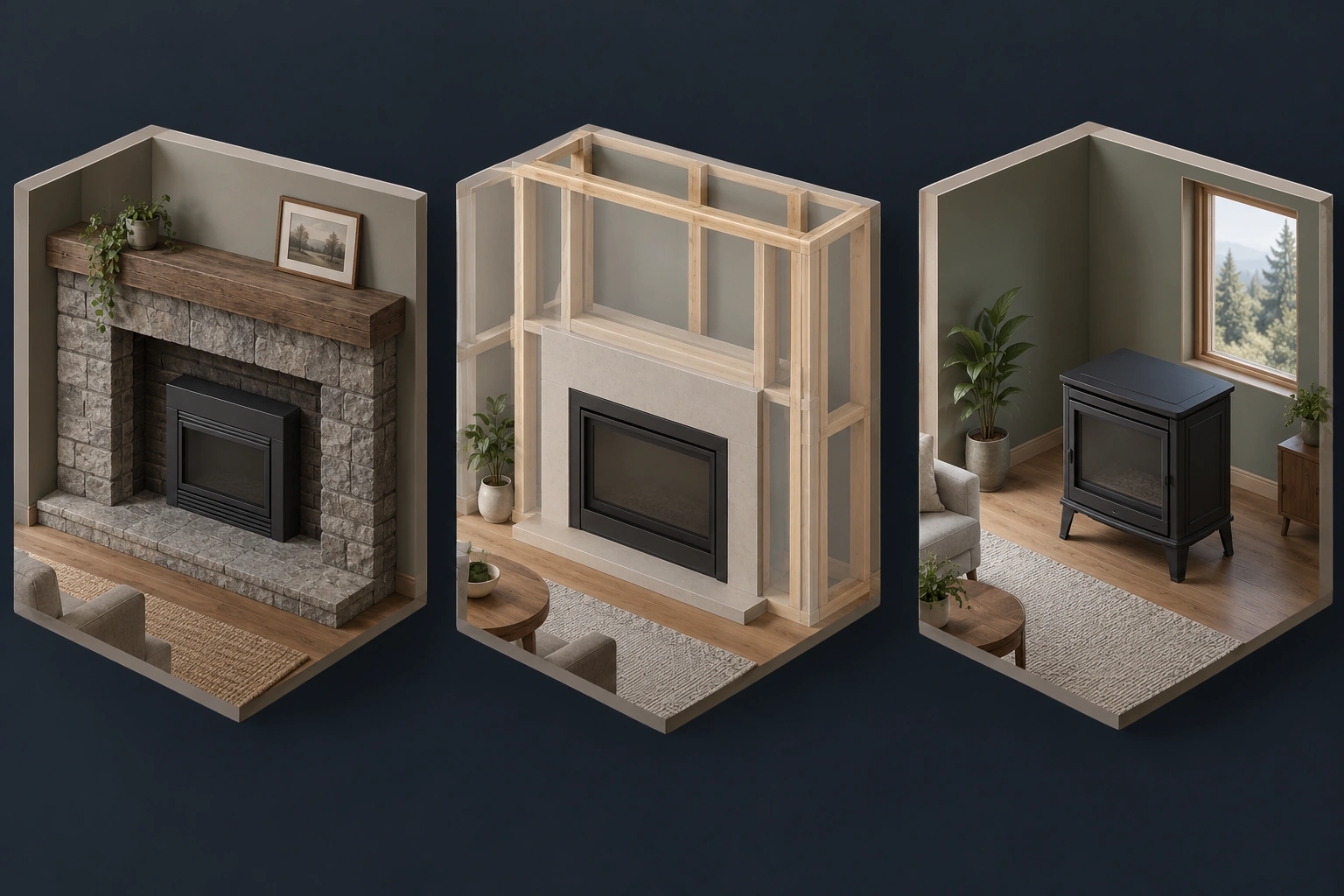
The left picture illustrates an insert in an existing fireplace opening. The centre illustrates a built-in fireplace within wall construction. The right illustrates a freestanding stove with its own body. The actual model and vent arrangement are not shown.
About this illustration
The picture cannot identify this home’s model, fuel, vent design or condition. This is a conceptual teaching model, not an assessment of your home.
6 picture lessons appear beside the questions in this guide. Use them to understand the explanation, then consider what it means for your home.
What exactly is installed in the home?
A gas fireplace burns fuel to make heat. Its burner and firebox hold the fire; its air and venting arrangement supports combustion; other surfaces or passages deliver warmth to the room. Start by identifying the appliance, rather than treating an attractive front as a description of everything behind it.
Before an ordinary viewing or document check: if gas is suspected indoors, leave immediately without using switches or appliances. Call the gas utility or emergency services from outside. For a CO alarm or suspected CO exposure, including possible symptoms, leave for fresh air and call emergency help outside. Do not search for the source.
For CO, Health Canada says to return only after a professional fixes the problem. Do not wait for HomeAI, a showing appointment or a routine service visit. The current emergency sources govern these actions; the older fireplace booklet contains advice that this guide deliberately does not repeat.
For a routine purchase enquiry, ask for the model, fuel, owner manual and installation file. An insert fits into an existing fireplace opening; a built-in unit forms part of the surrounding construction; a freestanding unit has a separate stove-like body. Have the qualified provider identify the actual form and arrangement.
Ask the seller what the fireplace is used for: occasional atmosphere, room heating or intended backup heat. Record that as their account. A listing description such as “gas fireplace” does not establish its particular heating role, installed options or the conditions under which it can be relied on.
Insert, built-in fireplace or freestanding stove?
The left picture illustrates an insert in an existing fireplace opening. The centre illustrates a built-in fireplace within wall construction. The right illustrates a freestanding stove with its own body. The actual model and vent arrangement are not shown.
Numbers identify the parts explained below.
- Insert and opening
The inserted appliance and the opening around it can have different histories.
- Built-in body
The fireplace sits within the surrounding wall construction. Ask which model and installation records describe it.
- Freestanding body
A separate stove-like body still needs its own model and venting records.
What does this illustration leave out?
The picture cannot identify this home’s model, fuel, vent design or condition. Compare the three forms, then ask for the actual model.
Which exact form, model and fuel are recorded for this home?
Explore this with HomeAI ↗Opens an editable question. Nothing is sent until you choose to send it.Where do combustion air and exhaust go?
Combustion is the burning of fuel with air. The burner receives gas, and the fire uses combustion air. The resulting combustion gases need the appliance’s intended exhaust route. Ask the provider to describe these jobs in ordinary language and identify where each route begins and ends in this home.
In a direct-vent design, outdoor air supplies combustion and combustion gases return outdoors through the appliance’s specified venting arrangement. That is a useful concept, not a drawing of your installation. A qualified provider must identify the actual appliance, approved components, complete route and outdoor termination.
Other designs can use different combustion-air or exhaust arrangements. The historical NRCan booklet distinguishes natural-draft, power-vented and direct-vent concepts. Do not identify one from the front glass, one exterior outlet or the seller’s description. Obtain the model instructions and have the provider explain which design applies.
Keep the combustion route separate from warm air circulating into the room. A room fan is not automatically an exhaust fan. A room grille is not automatically a combustion-air opening. The useful question is: which passage carries room air, which supplies the fire, and which carries combustion gases outdoors?
A visible outdoor end does not reveal every concealed joint or its condition. Tell the provider about later siding, roofing, landscaping or fireplace work that may be relevant to the route. Ask which parts were assessed and which need further access; do not remove covers or enter concealed spaces yourself.
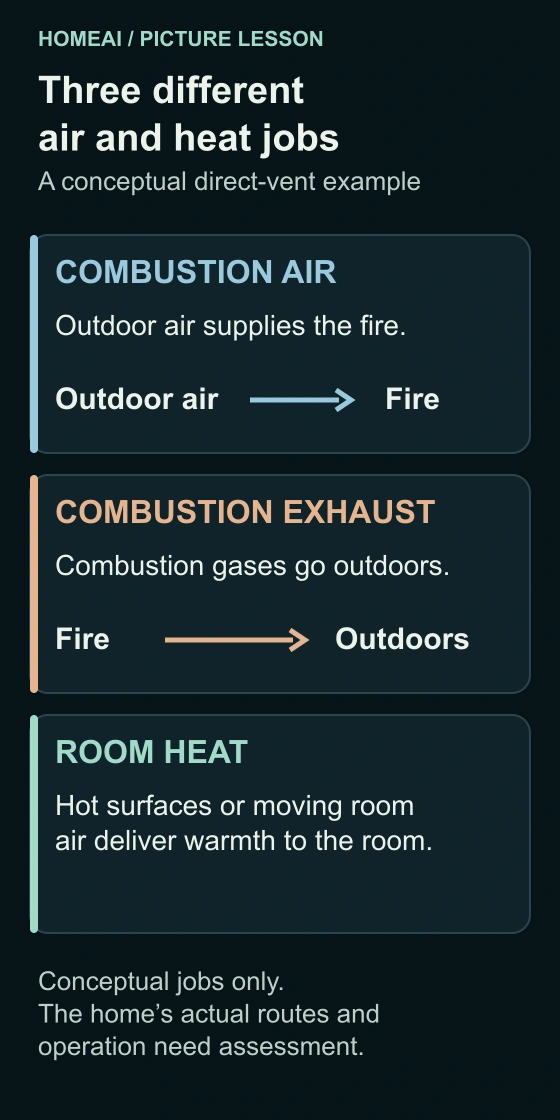
The fire’s air, its exhaust and room heat have different jobs
Outdoor air supplies combustion in this direct-vent example, and combustion gases return outdoors. Heat reaches the room through hot surfaces and, where applicable, moving room air. Room heat delivery is a separate job from combustion exhaust.
Numbers identify the parts explained below.
- Combustion air
The direct-vent concept brings air from outdoors to supply the fire.
- Combustion exhaust
Combustion gases use the appliance’s intended route back outdoors.
- Room heat delivery
Radiant warmth and heat carried by room air are distinct from the combustion route.
What does this illustration leave out?
The actual appliance design, concealed routes and assessed operation are not shown. Read each air and heat job separately below the picture.
Can the qualified provider identify combustion air, exhaust and room-heat delivery in the actual installation?
Explore this with HomeAI ↗Opens an editable question. Nothing is sent until you choose to send it.Read the complete diagram
The fire’s air, its exhaust and room heat have different jobs
- Combustion air: supply the fire
- In this conceptual direct-vent example, air comes from outdoors to support burning. Other appliance designs can have different arrangements. Ask the provider to identify the actual model and air source.
- Combustion exhaust: carry gases outdoors
- The combustion gases use the appliance’s intended exhaust route. The diagram labels a job without specifying installed pipe components, concealed joints, a termination or assessed flow.
- Room heat: warm the room
- Hot surfaces can radiate warmth, and some arrangements circulate room air around heated surfaces. A fitted room fan is not automatically a combustion-exhaust fan.
Conceptual jobs only, not a measured flow, universal design or installation drawing. The historical NRCan 2003/2004 body supplies concepts; current local/model requirements must be established separately.
What remains unknown: The actual appliance design, concealed routes and assessed operation are not shown.
Which job does each route perform?
- Combustion airSupplies air to the fire · Ask where it comes from for the identified model.
- Combustion exhaustCarries combustion gases outdoors · Ask which complete route and outdoor end were assessed.
- Room-air heat deliveryMoves warmth into the room · Ask which passages or fitted fan belong to this arrangement.
Conceptual function comparison. It does not show this property’s routes, approved components or assessed condition.
Further reading: Natural Resources Canada · All about gas fireplaces; Valor · H5 1100MN/1100MP homeowner manual.
What do the glass, barrier and trim each do?
The viewing glass lets you see the fire. On the named Valor H5 models, the manual requires the glass front to be in place and sealed for operation. The barrier screen has another job: reducing the risk of burns from contact with hot viewing glass. The surrounding trim finishes the appearance.
A barrier is not a promise that the glass is cool or safe to touch. FortisBC warns that fireplace glass can remain hot after the fire is off. Keep people away from hot surfaces and follow the actual model’s precautions. Do not touch the glass to check whether a fireplace was recently used.
For a buyer, ask whether the correct barrier and glass assembly are present and whether any damage has been assessed. The Valor manual prohibits operating its named models with removed, cracked or broken glass. Bring such a concern to a qualified provider; do not request a demonstration to find out whether it still works.
A mesh screen, decorative frame and glass panel may look like one front from across the room. Ask the provider to identify them separately. A photograph can record what is visible, but cannot establish the correct replacement part, intact seal, secure attachment or required separation from nearby materials.
Screen, glass and trim: what does each do?
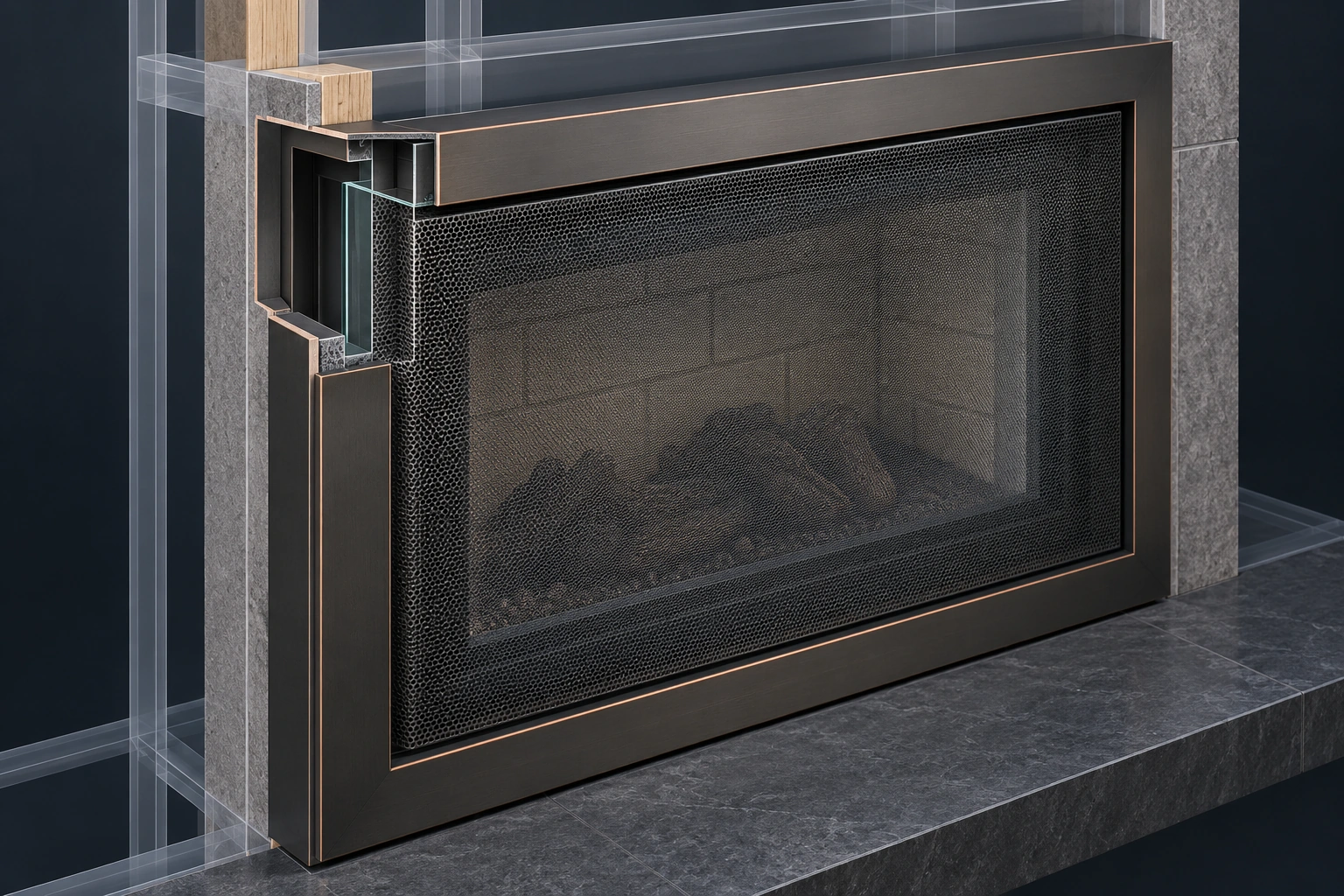
The screen helps reduce contact with hot glass. The glass is the viewing front, while trim finishes the outside edge. This corner cutaway shows a glass edge behind the screen on the left; it does not show a complete seal or confirm the correct parts.
Numbers identify the parts explained below.
- Barrier screen
Helps reduce the risk of contact with hot glass. The screen does not make the glass cool to touch.
- Viewing glass
The glass is the viewing front. The named H5 manual requires it in place and sealed; the generic picture cannot verify that seal.
- Decorative trim
A finishing frame is different from the glass and barrier.
What does this illustration leave out?
Correct parts, seal condition, installation and surface temperature remain unknown. Name the three parts; do not touch surfaces to check their temperature.
Does the qualified provider identify the correct glass and barrier for the actual model?
Explore this with HomeAI ↗Opens an editable question. Nothing is sent until you choose to send it.How does the fireplace warm the room?
Heat reaches the room through radiation and convection. Radiation transfers warmth from hot surfaces toward surrounding objects. Convection moves heat with air. Some fireplace arrangements allow room air to circulate around heated surfaces; a fitted circulating fan can help move that room air.
These heat-delivery jobs do not replace the combustion exhaust route. A fan that changes room-air movement can change where warmth is felt without assessing the fire, seals or venting. Ask the provider which room-air passages and optional equipment belong to the identified model.
A gas input rating describes fuel energy entering the appliance over time. Heating output concerns useful heat delivered under the stated conditions. Efficiency compares defined energy quantities. Ask which rating and test basis a label uses, rather than treating a large input number as room comfort or a predicted bill.
A warm sofa at a showing does not establish heating in distant rooms or during different weather. Give the provider your intended use and room arrangement. Ask whether the fireplace is intended as supplementary heat, and what separate assessment would be needed before relying on it for a broader heating plan.
Which controls and power supplies matter?
A control tells the appliance what to do; it does not necessarily power every function. Ask which control starts or stops the fire, which changes the flame request, and which operates a fitted room fan or another feature. Keep the fuel supply, control power and optional electrical equipment as separate questions.
The current Valor H5 homeowner manual provides a concrete example. It describes a handset and a wall control with different capabilities, along with battery-powered control components. Its remote appendix identifies an optional circulating-fan function but says lighting is unavailable on those appliances. A familiar-looking button does not establish an installed feature.
For the home you are buying, request the exact model and accessory manuals. Ask the qualified provider to explain the present controls, required power sources and any documented response to a power interruption. Do not infer that batteries, a pilot flame or a quiet fan make the whole arrangement suitable for backup heating.
A reported failure to start may involve different causes, such as a control problem or a supply issue. Record the seller’s account, any existing message and the relevant service report. Do not open the receiver, alter wiring, bypass a safety control or follow another model’s reset sequence to choose a diagnosis.
Which controls and power does the appliance need?
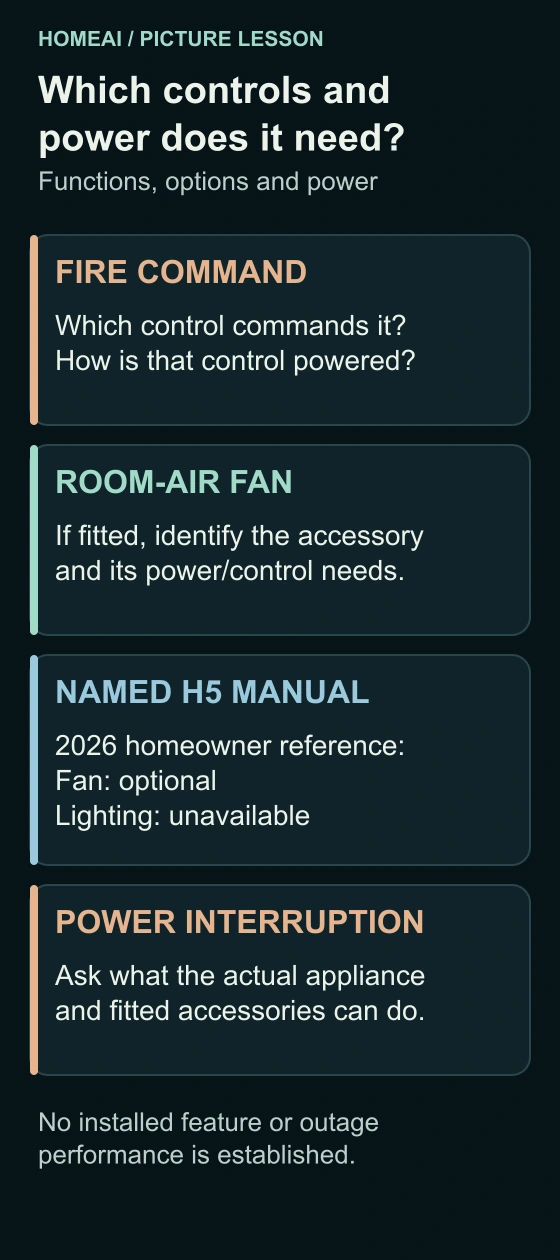
A control requests a function; the function’s power supply is a separate question. The 2026 H5 homeowner manual marks its fan as optional and lighting as unavailable. Those statements do not identify the options fitted in this home.
Numbers identify the parts explained below.
- Fire command and power
Ask which control commands the fire and how that control is powered.
- Named manual example
The H5 1100MN/1100MP manual lists an optional fan and unavailable lighting; another model needs its own documents.
- Power interruption
Ask which present functions and dependencies the actual model and accessory files establish.
What does this illustration leave out?
Installed options, power dependencies, tested operation and outage performance remain unknown. Ask about one installed function at a time.
Which installed functions and dependencies does the actual manual and provider identify?
Explore this with HomeAI ↗Opens an editable question. Nothing is sent until you choose to send it.Read the complete diagram
Which controls and power does the appliance need?
- Fire command
- Identify which actual control requests the fire function. Ask how its control is powered; a command symbol alone does not identify every dependency.
- Room-air fan
- If a fan is fitted, identify its accessory, control and applicable power requirements. A possible feature in a manual is not proof that the accessory is installed.
- Named H5 example
- The Valor H5 1100MN/1100MP homeowner manual 4008356-07, ©2026, marks a circulating fan as optional and lighting as unavailable. This is one named model reference, not a rule for all gas fireplaces.
- Power interruption
- Ask the qualified provider what the present appliance and accessories can do under the documented conditions. Batteries or a pilot flame do not establish whole-arrangement backup-heating capability.
Function questions only: no wiring, operating/reset sequence, battery count or outage guarantee. The owner manual is not the separate installation or accessory manual.
What remains unknown: Installed options, power dependencies, tested operation and outage performance remain unknown.
A control symbol and an installed feature are different questions
- Fire controlCommands the appliance’s fire function · Identify the present control and applicable instructions.
- Optional room fanMoves room air when fitted and operating · Confirm the actual accessory, control and power requirements.
- Named H5 exampleThe 2026 manual marks a fan option and unavailable lighting · This says nothing about another model or the options fitted in a real home.
The manual example is not a tested fireplace or an assurance that any function works during an outage.
Further reading: Valor · H5 1100MN/1100MP homeowner manual.
What changes when a gas unit uses an older fireplace opening?
A gas insert can occupy an opening that previously held another appliance or a wood-burning fire. The visible surround, original opening, current gas unit and present venting each have their own history. A newer insert receipt does not date every concealed part around it.
Ask for the installation documents that identify the insert and the connected venting arrangement. Have the provider explain how the existing opening and surrounding construction were addressed. An old chimney-cleaning invoice describes its stated work at that time; it is not automatically a record of the later gas installation.
A buyer may receive a mixture of old and new papers. Put them in date order and label the component each concerns. An appliance purchase, installation task, venting repair and inspection result can all be useful while answering different questions. Keep the actual reports with their access limits.
Ask which concealed questions affect your decision and what further assessment would answer them. Do not assume the old opening is unsuitable, or that a new front resolves everything behind it. The provider defines the technical scope; your transaction advisers handle permission, access and purchase terms.
Could a new surround or room renovation matter?
A surround is the construction or finish around the fireplace. Mantels, wall finishes, televisions and nearby furniture can change the setting in which the appliance is used. Ask which separation, opening and heat-management instructions apply to the exact installed model and accessories.
The named Valor manual illustrates why the model matters: it identifies particular room-air outlets and warns against covering them. That is not a universal layout for every fireplace. A provider should match the current arrangement to the applicable documents, including any optional heat-distribution system actually fitted.
Request records for later fireplace-facing, cabinet or equipment work. A photograph of an earlier room can help establish reported history without supplying concealed construction details. Ask whether the later work was included in a relevant assessment, especially when the appliance or its surrounding arrangement changed.
Do not copy a clearance distance from another fireplace or decide suitability from how warm a television feels. Ask the provider which instruction applies, what was observed or measured, and what remains unassessed. If proposed work needs local permissions or a different trade, have the responsible parties identify that scope.
What should installation and service records answer?
Begin with identification: address, appliance model, fuel, work date and responsible provider. Then ask what was installed, changed, observed or checked. A dated payment receipt is useful, but the description of the work and any separate findings are what connect it to the question you need answered.
Request the matching owner manual and installation instructions. They serve different readers. The owner manual explains the product and appropriate use; the installation instructions supply model-specific requirements for the responsible installer. The H5 owner manual read for this guide does not replace its separate installation file.
For service, ask what the visit covered: glass and seals, burner and ignition, controls, accessible air passages, venting and its outdoor end. FortisBC recommends a qualified provider and a completed checklist. Ask for the actual findings, recommendations and any follow-up, rather than describing “serviced” as an unrestricted approval.
If a report gives a test result, ask what was measured, under which conditions and against which applicable basis. Keep its units and locations attached. A flame photograph, fan sound or successful start is a different kind of observation from a recorded technical assessment.
Ask the relevant local authority and qualified provider which credentials, permissions and completion records apply at this address and work date. Canadian locations and manufacturer models have their own requirements. This guide supplies no national permit checklist, mandatory service interval or judgement that a supplied record meets local rules.
The owner manual, installation file and service report answer different questions
The owner manual explains the identified product. The installation file concerns stated installation work and arrangement. A service report describes the visit’s tasks, findings and follow-up. Keep each record attached to the question it answers.
Numbers identify the parts explained below.
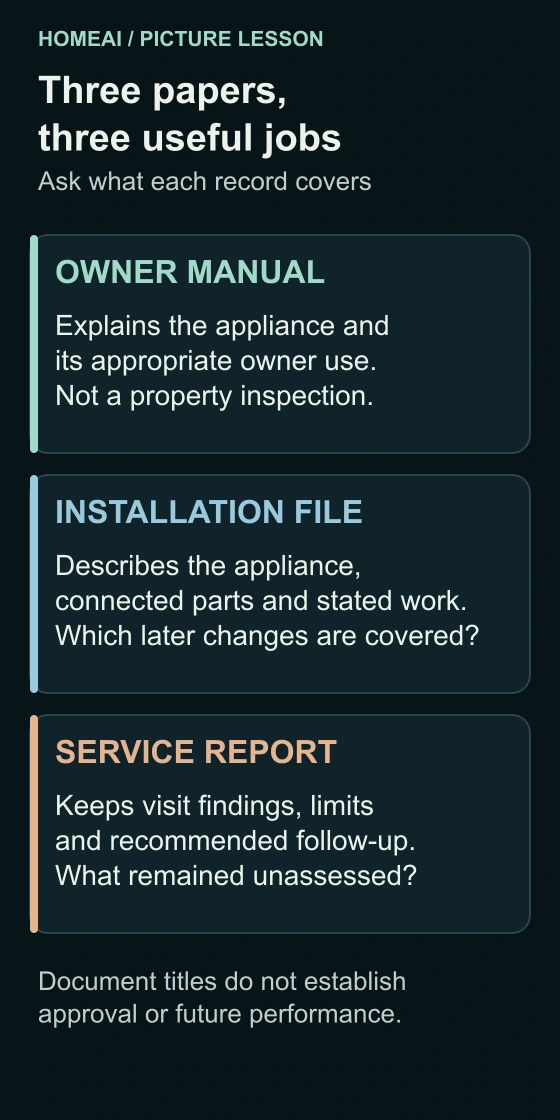
- Owner manual
Use the matching product manual; it is not an inspection of this home.
- Installation file
Ask which present components, connected arrangement and later changes the actual file covers.
- Service report
Keep the findings, access limits and unfinished follow-up beside the visit date.
What does this illustration leave out?
The home’s actual work, technical findings, local permissions and unassessed areas are not supplied. Match each document to its useful job below.
Which present component or later change is outside the supplied records?
Explore this with HomeAI ↗Opens an editable question. Nothing is sent until you choose to send it.Read the complete diagram
The owner manual, installation file and service report answer different questions
- Owner manual: explain the product
- Match the manual to the appliance model. It explains the product and appropriate owner use; it does not supply an actual property assessment or replace separate installation instructions.
- Installation file: describe the stated work
- Ask which appliance, connected arrangement and surrounding work the actual record covers, and whether later changes fall outside it. Its title alone does not establish completion, local permission or present condition.
- Service report: keep visit findings and limits
- Keep the visit’s tasks, technical findings, recommendations, access limits and follow-up together. A paid visit or successful start does not automatically clear the complete installation or its future performance.
The three papers are compared by job, not ranked as substitute approvals. Actual local/model documents and qualified scope are needed for this home.
What remains unknown: The home’s actual work, technical findings, local permissions and unassessed areas are not supplied.
Keep the document attached to its useful job
- Owner manualExplains the identified product and owner use · Not the separate installation instructions or a property finding.
- Installation fileRecords stated work and connected arrangement · Ask which present components and changes it actually covers.
- Service reportRecords the visit’s tasks, findings and recommendations · Keep inaccessible areas and unfinished follow-up visible.
A document title or paid invoice does not establish every installation question, local permission or future heating outcome.
Further reading: Valor · H5 1100MN/1100MP homeowner manual; FortisBC · Appliance maintenance and safety.
What can a buyer safely notice at a showing?
With permission, record the accessible whole front, visible barrier, controls and any readable model information from a normal safe position. Note the date and whether the appliance was operating when you arrived. Ask the seller for missing identity information instead of moving trim or reaching into a compartment.
Keep observations literal: a visible mark, damaged part, reported starting problem or supplied service recommendation. Ask when it was noticed and what assessment followed. Similar appearances may have different causes; a photo cannot measure gas concentration, identify a hidden leak or assess the complete installation.
A white film, glass condensation or a flame appearance can have model-specific explanations. The named H5 manual discusses such examples, but that does not diagnose an unfamiliar fireplace. Ask the provider whether the particular observation is expected for this model and conditions, or needs investigation.
Do not remove the glass, rearrange the fuel bed, probe a vent, manipulate gas controls or run an improvised operating test. Suspected indoor gas, a CO alarm or possible CO exposure belongs to the immediate outside-first response, even when a showing or purchase deadline makes the timing inconvenient.
How would these questions change a fictional purchase?
In this invented example, buyer Sam receives a recent gas-insert invoice, an older chimney-cleaning receipt and photographs of a newly finished fireplace wall. The listing calls the fireplace backup heat. No current model manual, installation report or written explanation of power dependencies has yet been supplied.
Sam separates four questions. Which gas appliance and fuel are installed? How do its combustion air and exhaust reach their destinations? Which parts heat the room? What does the present control arrangement depend on? The photographs help locate questions; they supply no diagnosis or approval.
The recent invoice might accurately describe the insert work, while the older receipt concerns the previous arrangement. The wall photographs could document a later change that needs comparison with model instructions. Missing records do not prove a damaged vent or unsuitable surround; they identify what Sam still needs to learn.
Sam asks for the complete files and a qualified assessment of the current arrangement and intended use. The provider is asked to state findings, access limits and any further work. Sam’s transaction advisers address timing and written commitments through the actual agreement.
The resulting decision is a better-defined enquiry, not an invented passing inspection. This example establishes no defect, repair price, accepted insurance cover or backup-heating capability. No real seller, buyer, provider or property is represented.
Sam’s fictional fireplace papers leave four different questions
In the invented case, an older cleaning receipt, newer insert invoice, later wall photographs and backup-heat description concern different parts and claims. Each needs its own matching record or assessment.
Numbers identify the parts explained below.
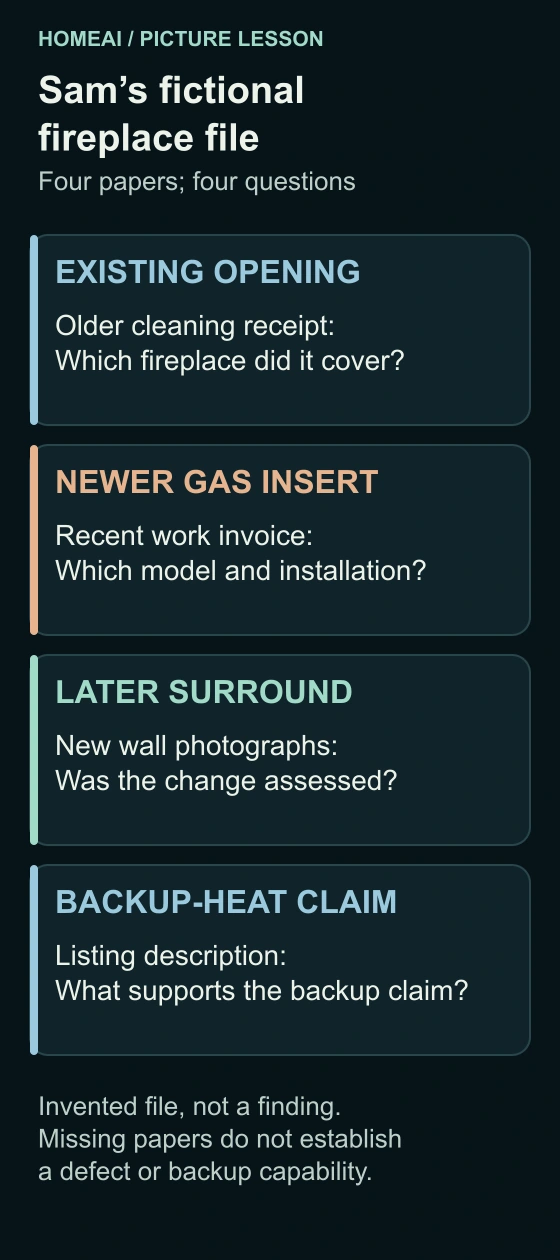
- Opening and insert
The older cleaning receipt and newer insert invoice can describe different arrangements and dates.
- Later surround
Photographs show an appearance or reported change; ask whether the present model and later work were assessed together.
- Backup-heat description
Ask for the actual model, installed controls, power dependencies and intended-use evidence.
What does this illustration leave out?
Every item is invented; no actual installation, defect, approval or backup-heating performance is established. This is Sam’s invented file, not an actual property finding.
Which actual installation and later-change records describe the current arrangement?
Explore this with HomeAI ↗Opens an editable question. Nothing is sent until you choose to send it.Read the complete diagram
Sam’s fictional fireplace papers leave four different questions
- Existing opening: older cleaning receipt
- Sam’s invented older receipt concerns its stated earlier arrangement and work. It does not automatically describe the later gas installation.
- Newer insert: recent work invoice
- The fictional invoice records stated work. Sam still asks which model, fuel, connected arrangement and installation report describe the present appliance.
- Later surround: wall photographs
- The invented photographs help locate a reported later change. Sam asks whether the surrounding work was compared with the actual model’s instructions; the image does not establish concealed construction or suitability.
- Backup-heat claim: listing description
- In this fictional file, the listing’s claim lacks a supplied written account of current controls and power dependencies. Sam requests documents and qualified assessment instead of assuming a defect or an outage capability.
All people, papers, relative dates and claims in this example are invented. Missing records supply questions, not a passing inspection, defect, repair price or real property conclusion.
What remains unknown: Every item is invented; no actual installation, defect, approval or backup-heating performance is established.
Who should answer the unresolved technical questions?
Use a provider qualified and authorised for the relevant fuel, appliance and work in your location. Ask about experience with the exact model and whether the booked visit includes the appliance, connected venting and relevant surroundings. A general inspection and a targeted gas-appliance assessment can have different scopes.
Your realtor can coordinate record requests and assessment access. Confirm any claimed HAUSE training, specialist role and local availability rather than assuming them from the brand. A referral is an introduction; ask who will perform the technical work and what written result you will receive.
Your insurer answers its coverage and document questions. Your legal and transaction advisers address reliance, agreements and commitments. A contractor quotation answers its proposed work and price. Keep these responses separate from the specialist’s actual findings about the appliance.
When a report recommends further work, ask which question it will resolve and how completion will be checked. A narrower visit can be entirely useful when its limits are clear. Avoid filling an inaccessible-area gap with a reassuring image, an assumed credential or an unsupported label.
What belongs in the fireplace handover?
Keep a findable folder with the identified model and fuel, owner and installation manuals, installed accessory information, complete service reports, relevant installation or renovation records and outstanding recommendations. Preserve dates and the component covered by each document.
Have the qualified provider explain normal owner controls and the maintenance plan for the actual model, condition and use. Keep the relevant alarm instructions and emergency contacts accessible. No universal calendar interval, battery arrangement or reset sequence is established by this guide.
If you plan a room renovation or a change in how the fireplace is used, give the provider the intended work and current files. Ask which connected questions need review. Keep later completion evidence beside the original installation history so the next owner can follow what changed.
Before relying on the fireplace, be able to name the appliance, explain the separate combustion and room-heat jobs, and identify the provider’s remaining questions. For broader heating or outage planning, use the companion guides and an appropriate property-specific assessment.
Keep learning about the connected parts
Practice the distinction.
An insert invoice, an older chimney receipt and a backup-heat claim
Fictional buyer Sam receives three different pieces of information: a recent gas-insert invoice, older chimney-cleaning history and a listing description of backup heat. The current manuals and power explanation remain missing.
Reported observations
- The supplied invoice names its stated insert work.
- The chimney receipt predates that work.
- Later fireplace-wall photographs provide reported renovation context.
- No present installation assessment or backup-heat finding has been supplied.
Compare the explanations
Expand each possibility to see the evidence needed to distinguish it. Similar symptoms can have different mechanisms.
The records describe different useful tasks
Their dates and component descriptions may be accurate while leaving the present connected arrangement unanswered.
Complete dated records, matching model instructions and the provider’s explanation of what each task covered.
Later work or intended use needs a further review
The new finish or backup-heating plan may raise a question outside the supplied work descriptions.
A qualified scoped assessment of the present arrangement, relevant changes, intended use and control/power dependencies.
A useful next question
Request the complete files and a named technical assessment; have the transaction advisers address access, timing and commitments through the actual agreement.
Invented example only: no actual defect, passing inspection, insurance decision, repair price or outage-heating capability.
Know what the words mean.
- Burner
- The part where supplied gas burns with air to produce heat.
- Firebox
- The chamber containing the fire; its construction and connections belong to the specific appliance.
- Combustion air
- Air used by the fire. Its source is distinct from air circulating around the room.
- Exhaust route
- The intended route carrying combustion gases from the appliance outdoors.
- Direct vent
- A design using outdoor combustion air and carrying combustion gases outdoors through its specified venting arrangement.
- Insert
- An appliance fitted into an existing fireplace opening; the current appliance and connected arrangement need identification.
- Barrier screen
- A model-specific protective barrier intended to reduce burn risk from contact with hot glass; it does not make the glass cool.
- Radiation
- Heat transfer from hot surfaces toward surrounding objects.
- Convection
- Heat transfer carried by moving air.
- Surround
- The construction or finish around the fireplace, including its relationship to the model’s instructions.
Questions to bring
to the conversation.
- Which model, fuel and appliance form are actually installed?
- Where does combustion air come from, and where does the complete exhaust route go?
- Which glass, barrier, room-air passages and optional equipment belong to this model?
- What do the controls and power sources support, and what remains unknown about backup heat?
- Which installation, service and later-change records describe the arrangement now?
- Who will assess the unresolved question, with which access and written scope?
Separate a showing observation, an existing record and a new professional assessment. Unknown means a question remains; it does not automatically mean a defect.
Use the evidence planner ↗Go to the source.
Original HomeAI explanation informed by these public references. Sources support the underlying guidance; they have not reviewed or endorsed HomeAI. Diagrams are conceptual, and calculator outputs depend on your inputs.
Current Health Canada, municipal and utility guidance supports the safety actions. NRCan’s older fireplace booklet supplies historical design concepts. The 2026 Valor H5 owner manual applies only to its named models; it does not establish this home’s installation, condition or local approval.
Publication & source review
First published .
Sources reviewed .
- Natural Resources Canada · All about gas fireplaces
Where this reference applies
Jurisdiction: Canada; historical federal consumer booklet
Edition: Body refers to 2003/2004; issued April 21, 2009; page modified January 7, 2025. A recent page date does not update the booklet.
Source reviewed: 2026-10-06 · America/Edmonton
Complete retained substantive body read. Appliance forms, combustion/heat-delivery roles and venting concepts only. Historical prices, ratings, approval statements, availability and active emergency advice are excluded.
- FortisBC · Appliance maintenance and safety
Where this reference applies
Jurisdiction: British Columbia; utility consumer guidance
Edition: No substantive publication or revision date displayed in the retained body.
Source reviewed: 2026-10-06 · America/Edmonton
Complete substantive body read. Hot-glass warning, actual manufacturer instructions, qualified fireplace service/checklist and outside-first gas emergency footer. No maintenance interval or BC contractor rule is assigned nationally.
- Health Canada · Carbon monoxide: preventing exposure
Where this reference applies
Jurisdiction: Canada; current federal public-health guidance
Edition: Page date November 12, 2024.
Source reviewed: 2026-10-06 · America/Edmonton
Complete successful web body read; separate ordinary GET timeout is retained. CO alarm: leave immediately, do not find the source, call emergency help outside and return only after a professional fixes the problem.
- Health Canada · Carbon monoxide: symptoms of exposure
Where this reference applies
Jurisdiction: Canada; current federal public-health guidance
Edition: Page date November 12, 2024.
Source reviewed: 2026-10-06 · America/Edmonton
Complete substantive body read. Possible CO symptom descriptions do not diagnose this reader or identify a particular appliance; this page is not the source for an emergency or treatment instruction.
- City of Calgary · Home maintenance and CO/gas response
Where this reference applies
Jurisdiction: Calgary, Alberta; municipal emergency education
Edition: No substantive page revision date established; copyright/footer dates are not treated as publication dates.
Source reviewed: 2026-10-06 · America/Edmonton
Complete substantive body read. Possible CO symptoms or an alarm mean leave and call 911; suspected indoor gas means leave without using switches/appliances and call outside. Local testing intervals, installation statements and reassurance examples are excluded.
- Valor · H5 1100MN/1100MP homeowner manual
Where this reference applies
Jurisdiction: Named Canadian manufacturer reference; H5 1100MN natural-gas and 1100MP propane models only
Edition: 4008356-07; ©2026 Miles Industries. HTTP Last-Modified February 4, 2026 is separate transport evidence.
Source reviewed: 2026-10-06 · America/Edmonton
All 32 text pages read; actual cover, safety, parts and remote-control page pixels inspected. Model-specific glass/barrier, intended use and distinct control/optional-feature examples. Owner operations, service procedures, intervals, numerical settings and US-specific provisions are excluded. This is not the separate installation manual.
Have a question about your home?
Start with the symptom, timing and what you have observed.
Ask HomeAI