- Construction awareness is useful when it produces a clear question and an appropriately scoped assessment.
- Verify the professional, actual qualifications, engagement and referral relationships for the property’s jurisdiction.
- Keep technical findings, official records and transaction decisions connected without merging their responsibilities.

Open framing, insulation specimens, closed equipment and an illustrative buried sanitary route are exposed.
About this illustration
Member capacity, connections, assembly continuity, commissioned performance and pipe support are not certified by this model. This is a conceptual teaching model, not an assessment of your home.
3 picture lessons appear beside the questions in this guide. Use them to understand the explanation, then consider what it means for your home.
What does construction awareness add to an agent’s work?
A useful agent helps you ask what lies behind your purchase assumptions. Want an opened kitchen, an EV charger or a dry basement office? Ask which existing information and professional assessment could change that plan. Construction awareness matters when it turns an attractive feature into a specific evidence question, rather than a quick declaration that the house is sound.
RECO’s Ontario guidance describes buyer services such as property and neighbourhood information, zoning or permitted-use enquiries and referrals to other professionals. Its inspection guidance also cautions that an agent may identify visually obvious issues while underlying problems remain. Keep that distinction: recognizing a question does not establish the technical answer.
During an agreed showing, locate ordinary visible concerns safely and record what was said. An agent can help request records and coordinate the next conversation. The relevant inspector, trade or designer explains the technical assessment within their engagement. Ask for examples of how the agent has organized such enquiries, with client privacy protected; a confident property vocabulary alone is not evidence of specialist competence.
Whose interests and responsibilities should I clarify first?
Ask who represents you, which brokerage provides the service and what your agreement covers. A builder’s representative, seller’s agent, buyer’s agent and independent professional can participate in the same visit while having different engagements. Introductions and friendly advice do not explain those relationships. Obtain the applicable representation information before assuming whose confidential advice you are receiving.
In Ontario, RECO explains the duties owed to clients and the handling of conflicts. Those Ontario rules are not a Canadian contract template. Ask the regulator and your legal adviser about the process that applies to your transaction. The buyer’s aims should be explicit: intended use, proposed work, technical concerns and the questions that could change commitment.
Keep a responsibility row for each enquiry. The agent may coordinate access or a record request; the inspector authors their own findings; the specialist assesses the defined technical question; your legal professional addresses the agreement. Confirm who will deliver the answer and when. A task copied to several people can otherwise look assigned while nobody has accepted it.
How can I verify a professional beyond a recommendation?
Start with identity, current status and relevant work. RECA’s ProCheck lets consumers check Alberta real estate professionals and licence types; RECO explains Ontario’s public register for agents and brokerages. Use the authority for the address and profession elsewhere. A current registration answers an authorization question; it does not by itself establish construction experience, specialist qualifications or availability.
Inspector requirements also vary. Alberta directs consumers to check both the inspector and inspection business licensing. BC inspectors are licensed through Consumer Protection BC. The federal Office of Consumer Affairs advises checking applicable licensing, training, experience with the home type, a sample report, written scope and insurance. Do not generalize one province’s licence system to all Canada.
For an engineer, electrical contractor or other specialist, verify the applicable registration or trade authorization with its relevant authority and discuss experience with this question. Ask who will perform and sign the work, which methods they offer and what their proposal excludes. References, relevant anonymized examples and a readable sample deliverable can help you assess the fit without promising an outcome.
What should the general inspector handle—and hand onward?
Ask the inspector to explain the contracted systems, methods and access before booking. CAHPI’s member standard describes accessible visual observations and recommendations for further evaluation where appropriate; it also permits appropriately qualified additional services. The general inspection can provide important findings while a separate measurement or specialist investigation answers a narrower question.
Consumer Protection BC describes inspectors as trained to recognize major concerns but not experts in every field. Its report requirements include opinions on contracted items, areas requiring expert advice and exclusions. Ask which kind of further assessment is appropriate and why. In BC, the regulator also says an inspector should not provide repair estimates or refer a contractor; obtain independent proposals through the appropriate route.
Keep a handoff tied to the actual report location and recommendation. “Further electrical assessment for the stated concern and proposed equipment” is more useful than “check everything again.” Request an explanation of what new evidence would answer the question. Do not treat a specialist’s involvement as proof that the original inspector failed, or a long general report as proof that no specialist question remains.
Which home-system questions reveal a useful handoff?
For electrical plans, give a qualified electrical professional your intended equipment and the available service records. Ask what assessment is needed to determine the implications for that home. A modern-looking panel, an equipment rating or spare breaker space is starting information, not the assessment itself. Buyers should not remove covers or perform live measurements during a showing.
For the envelope, ask which assembly information and observations address a reported stain, window concern or proposed insulation change. A neat exterior finish does not reveal every concealed connection. For heating and ventilation, ask what the inspection observed and whether measured performance or design information is available for the concern. A thermostat demonstration and a specialist performance assessment are different evidence requests.
For an altered layout, ask the relevant qualified designer or engineer which existing drawings and assessment the proposal requires. For an apparently shared roof, drain or exterior wall, have the legal and building records establish responsibility and access. The property-type companion guide expands that interface. These are examples of routing questions; the relevant professional defines suitable methods and the applicable authority’s requirements.
Trace the separate control layers
The separated planes help distinguish structure, insulation and weather-facing layers.
Numbers identify the parts explained below.
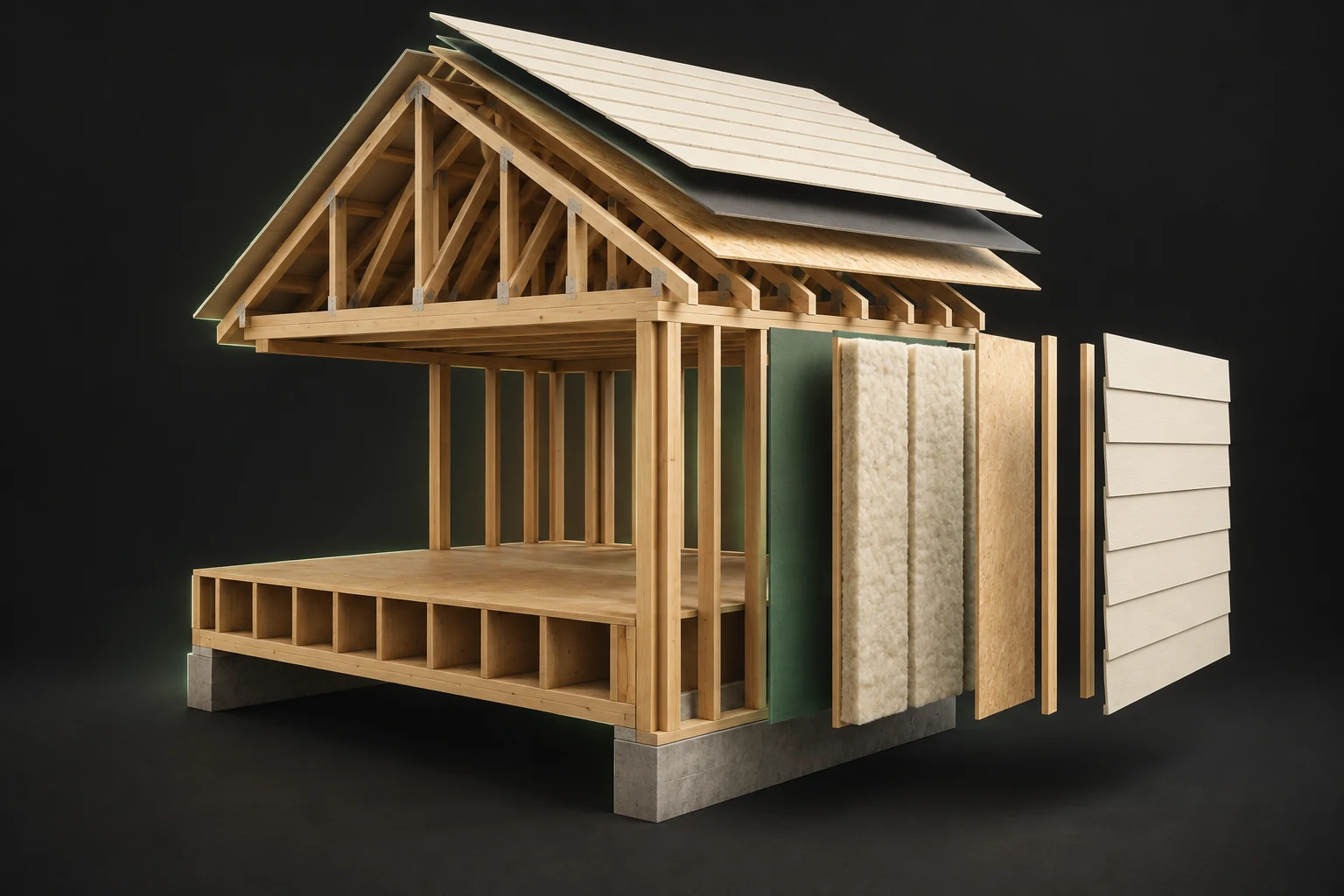
- Roof interface
Ask how the roof meets the wall and how that junction was assessed.
- Insulation space
Thickness in an illustration is not a performance rating.
- Exterior planes
A face finish does not reveal the air/water control behind it.
What does this illustration leave out?
Actual layer order, material specifications, junction continuity and moisture condition require records or assessment. This illustration explains an idea. It is not an installation guide.
Which records or qualified assessment explain the control-layer continuity and moisture limits of this assembly?
Explore this with HomeAI ↗Opens an editable question. Nothing is sent until you choose to send it.Why ask about buried services on a brand-new home?
A completed yard shows a surface. It does not show the inside of the buried sewer or the extent of earlier assessment. Ask the builder for the service route, relevant inspection records, any available footage and the chronology of subsequent work. New construction changes the questions you ask; it does not make every home defective or impose a universal sewer-camera requirement.
A home-aware agent can help turn that gap into a specialist brief: which service segment needs evidence, what agreed access is available, which endpoint is intended and what deliverable is required? If a camera assessment is appropriate, discuss complete footage, a written interpretation, distance reference and visibility limits. Have the specialist explain the actual method; do not open a cleanout or handle sewage to prepare it.
Construction traffic can prompt a question without supplying a diagnosis. An attributed report of trucks near the presumed route does not establish the route, buried conditions, damage or cause. Request the chronology and let a qualified drainage or civil professional explain what further evidence is useful. Keep technical findings separate from builder responsibility, warranty coverage and purchase terms; those need their own relevant answers.
See what finishes can conceal
Open framing, insulation specimens, closed equipment and an illustrative buried sanitary route are exposed.
Numbers identify the parts explained below.
- Exposed stage
Stage records can document specific work before it disappears behind finishes.
- Closed services
Ask for installation, inspection and commissioning records; keep hazardous equipment closed.
- Buried routes
The white sanitary route and dark foundation-drainage context are separate. Gaps are cutaway simplifications, not a defect finding.
What does this illustration leave out?
Member capacity, connections, assembly continuity, commissioned performance and pipe support are not certified by this model. This illustration explains an idea. It is not an installation guide.
Which new-build stages and commissioning records should I review, and what remains outside each inspection scope?
Explore this with HomeAI ↗Opens an editable question. Nothing is sent until you choose to send it.How would a fictional new-build team follow that question?
Fictional example: a buyer tours an invented new house. The sod looks finished. Someone reports recent truck movements near what they believe is the service route. The supplied construction record does not identify a later camera assessment. No actual home, damaged pipe, contractor mistake or warranty outcome is represented; these are invented facts for understanding the handoff.
The agent helps obtain the available route and dated records and coordinate permitted access. A qualified drainage specialist defines the scope. Suppose an invented report describes an apparent interior distortion at a stated distance, with the reached endpoint and visibility limitations recorded. That remains the specialist’s observation and interpretation; the camera does not establish which truck, if any, caused it or every external support condition.
The buyer asks what further evidence is needed to locate and interpret the concern. The builder receives the relevant technical record through the agreed process, and the advisers address responsibility and timing. If corrective work is agreed, the file should identify its scope and appropriate completion evidence. The example demonstrates why the original question matters without promising that a scope will find a defect or a builder must pay.
How should I evaluate referrals and possible conflicts?
Ask how a provider was selected, whether anyone receives compensation or another benefit, and what alternatives you may consider. In BC, BCFSA explains written disclosure of referral remuneration from third parties, including its source and amount or calculation. That is a BC disclosure example; it does not authorize every arrangement under another profession’s obligations.
CAHPI’s member ethics code separately restricts compensation for inspection referrals, paid recommendations and arrangements tied to findings or a sale. It warns that displaying its code does not verify membership. Ask which code and regulator govern the proposed provider and independently check the claimed membership. A disclosed relationship can still require a different response under the applicable rules.
Keep selection focused on the question, qualifications, independence and deliverable. Ask whether an assessment is separate from a repair quotation and whether recommending work creates an interest that needs clarification. Receive the written finding directly under the agreed reporting arrangement. The goal is to understand and evaluate the relationships, not to assume every agent referral is improper or every independent advertisement is suitable.
What belongs in the specialist evidence brief?
Use a short, complete brief: property and component; the decision you are trying to make; exact location; dated observed or attributed history; relevant full report section; available records; known access limits; and requested deliverable. Mark a suspected cause as a question. Do not compress “source not established” into “confirmed leak” when forwarding the concern.
Ask the recipient to confirm whether they can answer that question, what assessment they propose, what permission or access is required and what remains outside the engagement. A useful response explains findings and reasoning, not only a work price. Where a quote follows, keep assumptions, excluded work, restoration and any further assessment distinguishable.
Preserve changes between versions. New evidence can refine the question, alter a proposal or leave another gap. Confirm who interprets technical implications and who addresses the transaction choices under the actual agreement. The agent can coordinate the handoff and timing while the report’s author retains their professional responsibility. A price concession, accepted offer or builder email is not a technical verification of completed work.
Water comes in; used water leaves through a different system
Supply pipes bring water to taps and appliances. After use, water leaves each sink through a drain and trap before joining the larger drainage route. The trap holds a water seal that limits gas passage into the room. Venting lets air circulate in the drainage system and helps protect those seals. Following these different jobs makes a repair record much clearer than calling everything plumbing.
Numbers identify the parts explained below.
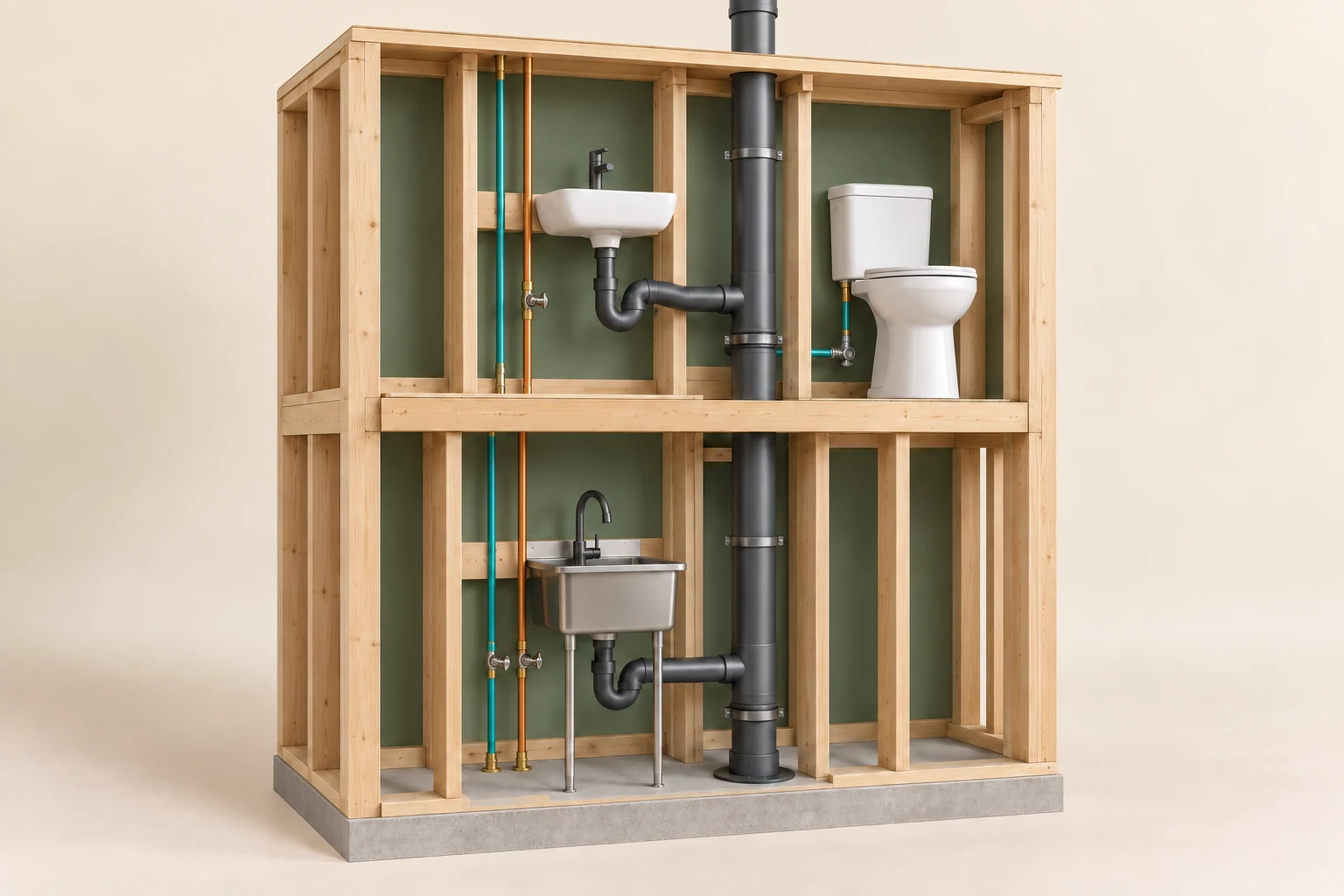
- Water supply
The narrow runs illustrate water delivery to fixtures. Incoming pressure provides the push; the drains carry used water away separately. A supply replacement record should name the branches and endpoints it covers.
- Sink trap
Water retained in an installed trap forms a barrier against gas from the drain. The curved shape helps locate that part here, but the picture does not show its retained water or establish its condition.
- Drainage and venting
The larger vertical pipe illustrates a stack carrying drainage between floors. Venting has the separate air-circulation and trap-protection job. Ask where each fixture drains and how its trap is vented; those complete connections are not drawn.
What does this illustration leave out?
The cutaway omits the tap connections, water inside the traps and a complete vent route to outside air. Pipe colour does not identify material. Ask a qualified plumber to explain the actual arrangement; this picture supplies no local design or approval. This illustration explains an idea. It is not an installation guide.
Which pipes supply this fixture, where does its used water go, and how does the actual vent arrangement protect its trap seal?
Explore this with HomeAI ↗Opens an editable question. Nothing is sent until you choose to send it.How can I request a HAUSE-trained realtor and judge the fit?
Ask the HomeAI team for a HAUSE-trained realtor introduction with your location, property type, purchase or sale stage and the home-system questions you want help organizing. Confirm actual availability, relevant training, licensing and the proposed role before treating an introduction as established. This guide supplies no certification standard, published training curriculum, verified roster or guaranteed introduction.
Discuss the practical service you need: help collecting technical records, asking clear questions, arranging permitted specialist access and keeping findings connected to your property decision. Ask how they handle a new-build sewer question, an electrical upgrade plan or an unclear shared-maintenance responsibility. Look for a specific evidence process and clear professional handoffs rather than a promise that they can personally assess every system.
Keep the same expectations when selling. Supply accurate records with their dates and scope, seek qualified clarification for consequential uncertainties and obtain advice about disclosure obligations locally. After buying, retain the team’s evidence in your Home Plan for maintenance and later alterations. A well-coordinated team makes the next question easier to answer while preserving who can responsibly answer it.
Keep learning about the connected parts
Practice the distinction.
Fictional new build: a useful question before assuming the sewer is settled
An invented finished yard, attributed truck movements and an incomplete record chain prompt a scoped buried-service enquiry. The example is not an actual builder claim.
Reported observations
- Finished sod reveals the surface rather than the buried service interior.
- Truck movements near a presumed route are attributed, not a proven damage cause.
- A later fictional camera finding retains its reached extent and interpretation limits.
Compare the explanations
Expand each possibility to see the evidence needed to distinguish it. Similar symptoms can have different mechanisms.
The existing records may answer part of the question
Route and construction chronology can inform a qualified specialist’s next scope.
Property-specific records with address, date, author and relevant assessed segment.
Further technical evidence may be needed
An apparent camera concern can leave location, cause or external support unresolved.
A qualified professional specifies appropriate further assessment and its limitations.
A useful next question
Coordinate authorized access and a specific technical deliverable, then address any proposed work and responsibility with the appropriate team.
No actual defect, vehicle-causation finding, mandatory sewer scope, warranty entitlement or guaranteed correction is supplied.
Know what the words mean.
- Professional handoff
- A transfer of a defined question and relevant evidence to a person qualified and engaged to answer it.
- Referral relationship
- The selection, compensation or other connection behind a professional introduction, to be evaluated under applicable obligations.
- Evidence brief
- A concise record of the question, location, source information, access and requested deliverable.
- Scope boundary
- The part of a question or property outside the booked professional assessment.
- Attributed history
- Information recorded with the identity of who supplied it, without silently treating it as independently verified.
- Completion evidence
- The specified record or assessment of what was delivered and checked, retaining its limits.
Questions to bring
to the conversation.
- Who represents me, what service did I agree to, and what conflicts or referral relationships need disclosure?
- Have licence or registration, relevant experience and claimed qualifications been independently checked?
- What question does each booked inspection or specialist assessment answer?
- Which records and assessments concern hidden services or my intended changes?
- Does each handoff identify the location, evidence, access, deliverable and remaining uncertainty?
- If requesting a HAUSE-trained realtor introduction, have actual training, location, licensing and availability been confirmed?
Separate a showing observation, an existing record and a new professional assessment. Unknown means a question remains; it does not automatically mean a defect.
Use the evidence planner ↗Go to the source.
Original HomeAI explanation informed by these public references. Sources support the underlying guidance; they have not reviewed or endorsed HomeAI. Diagrams are conceptual, and calculator outputs depend on your inputs.
Publication & source review
First published .
Sources reviewed .
- CMHC — Homebuying Step by Step, current guide
- Office of Consumer Affairs — home inspections
- Alberta — hiring a home inspector
- Consumer Protection BC — home inspections
- CAHPI — inspector standards and Code of Ethics
- CAHPI — 2024 National Standards of Practice
- RECO — working with a real estate agent
- RECO — home inspections
- RECO — public registration checks
- RECA — ProCheck
- BCFSA — disclosure information
Have a question about your home?
Start with the symptom, timing and what you have observed.
Ask HomeAI